|
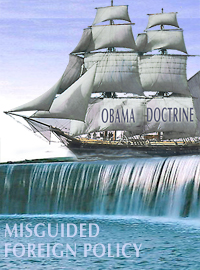
Twice in the last several months, forces hostile to American interests have launched aggressive naval maneuvers against U.S. allies. And twice have the Administration’s reactions been virtually non-existent.
|
|
| In a desperate bid to inject his boss with some much-needed gravitas, White House Press Secretary Robert Gibbs recently revealed to the press corps that President Obama’s nightstand reading included a biography of Theodore Roosevelt, the man who sat in Obama’s chair almost exactly a century prior. Let’s hope the president is using a highlighter.
If Obama pays close attention to TR’s legacy (instead of merely looking for personal similarities – his seeming default with Abraham Lincoln and Franklin Roosevelt), he’ll note how deeply the 26th president was influenced by the legendary naval strategist Alfred Thayer Mahan and his magnum opus “The Influence of Sea Power Upon History.” Mahan’s thesis that naval supremacy was a necessary ingredient for national strength inspired Roosevelt’s dramatic expansion of U.S. maritime forces and the subsequent worldwide tour of “The Great White Fleet” – an announcement to the world that America was an ascendant military power not to be trifled with.
Compare that to Obama’s reputation for resolve, which apparently dissolves upon contact with water. Twice in the last several months, forces hostile to American interests have launched aggressive naval maneuvers against U.S. allies. And twice have the Administration’s reactions been virtually non-existent.
In March, an unprovoked North Korean torpedo sank a South Korean navy ship, killing 46 of the south’s sailors. The international response was predictably tepid. UN Secretary General Ban ki-Moon called the incident “deeply troubling.” China’s foreign ministry said that they “noted” the attack.
The United States, which is usually and usefully a minority voice of moral reason, went ethically limp. Secretary of State Hillary Clinton went on the record with a rousing “"We are working hard to avoid an escalation of belligerence and provocation.” All well and good, Madame Secretary, but we think Pyongyang has that covered.
Across the Sea of Japan, no such placidity was possible. Last week, Japanese Prime Minister Yukio Hatoyama resigned his post after only eight months – a direct result of North Korea’s belligerence. Hatoyama had campaigned on a platform that included strong support for reducing the American military presence in Japan – particularly on the island of Okinawa, which is fertilized by the blood of over 12,500 American dead. But Tokyo – which finds itself in the straitjacket of a pacifist constitution that is yet another legacy of World War II – quickly realized that the American security guarantee was indispensible in light of North Korea’s provocations. That put them a step ahead of a languid White House.
Emboldened by the Korean example, an equally unrepentant and malicious foe made itself known in the waters off of Gaza on May 31. A Turkish ship named the Mavi Marmara attempted to run the Israeli blockade of the Hamas-controlled territory under the aegis of providing humanitarian aid. When members of the Israeli Defense Forces (armed with paintball guns rather than their holstered firearms) boarded the vessel to enforce the law, the “peace activists” on board erupted in violence, assaulting IDF members with baseball bats, knives and iron bars. As a result, nine people were dead by the end of the conflict.
In the weeks that have followed, Israel has been condemned by every corner of the international diplomatic community and the global press – this despite the fact that only those on the Mavi Marmara seemed to be engaging in malice aforethought. As Israeli forces sought to stop the ship before a physical confrontation, the radio response they received was “Shut up. Go back to Auschwitz.” And as Israel’s Ambassador to the U.S., Michael Oren, noted in the New York Times, a subsequent search of the ship revealed staged videos attempting to portray Israeli violence (the videos were shot during the day, while the incident occurred in the middle of the night).
Now Iran has jumped on board, pledging to support future attempts to run the blockade. This should come as no surprise given Turkey’s recent agreement to a nuclear fuel swap with the Islamic Republic, a gambit designed to undermine pressure for international sanctions on the mullahs’ regime. With President Obama’s hostility toward the Israeli government growing ever clearer, the Jewish state’s adversaries are exploiting a moment where they perceive Jerusalem’s power to be at its weakest in decades.
The Obama Administration is fond of excusing its foreign policy failures by suggesting that transformational changes take time. But the world already looks much different than it did in January 2009. North Korea has added nearly four dozen scalps to its belt; Turkey has migrated from the sole example of moderation among major Middle Eastern states to a country gripped by Neo-Ottoman fervor, and Israel and Japan, two of America’s most important allies, have reason to question whether the blank check of America’s security guarantee will bounce.
There’s a creaking sound in Oyster Bay, New York today. It’s coming from Theodore Roosevelt’s coffin.
|