




|
|
|


| Venezuela, Iran & Russia: A VIRUS to American Foreign Policy |
 |
|
By Ashton Ellis
Tuesday, October 19 2010 |
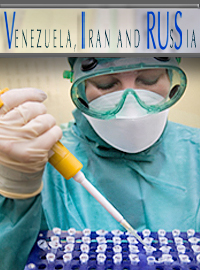
What do you call an axis of authoritarian regimes united by a rejection of the United States and free market capitalism? A ‘VIRUS’ for 21st century freedom. The acronym comes from an oft-repeated grouping of Venezuela, Iran and Russia; countries led by three governments that share a statist’s preference for top-down micro-management. Though technically elected, Venezuela’s Hugo Chávez, Iran’s Mahmoud Ahmadinejad and Russia’s Vladimir Putin each have eliminated effective competition by rigging their electoral systems to stay in power. How they use their power should concern all Americans. With technical and financial assistance from Russia, Venezuela and Iran are threatening to destabilize their respective regions as they race to develop nuclear weapons. Hugo Chávez is trying to reincarnate himself as Simón Bolívar; the failed Latin American version of George Washington, and namesake for Chávez’s ‘Bolivarian’ axis. That list of struggling socialist countries includes Bolivia, Cuba, Ecuador and Nicaragua. By denouncing former President George W. Bush as the devil without repercussion, and mugging for the cameras with President Barack Obama, Chávez is showing his neighbors that he is a player on the global stage. The recent announcement of a Russian-financed nuclear technology program in Venezuela further raises Chávez’s profile. It also solidifies him as a catalyst to radically reorient Latin America’s security situation. Already, Brazil is mulling whether to shift at least some of its nuclear apparatus towards bomb-making; a radical change of direction for one of the few nuclear nations that hasn’t weaponized its technology. Chávez’s formula for success is merely a repetition of the strategy played to perfection by Iran’s Mahmoud Ahmadinejad. First, take Russian money and know-how to build the infrastructure necessary to enrich uranium. Claim it is for “peaceful” purposes while refusing to be transparent with international inspectors. Then, mix hundreds of millions of petrodollars with an unyielding desire to become the region’s most feared nuclear nation. Flout economic sanctions as necessary. Buy off your own people when possible. The results are paralyzed neighbors and dependent citizens. “The debate now is whether Iran will have a nuclear bomb in one year or in three years,” says Dr. Ariel Cohen, Senior Research Fellow at the Heritage Foundation’s Kathryn and Shelby Collum Davis Institute for International Studies. According to Cohen, the development of an anti-American axis in the Middle East is being fomented by Iran’s nuclear ambitions with Russia’s assistance. “This puts pressure on America’s allies (in the region), and affects the energy and security situation in the Middle East.” Traditionally, regional leadership has been a prerogative of Egypt and Saudi Arabia. That will change when Iran gets the bomb. “If Iran develops a nuclear weapon,” warns Cohen, “the balance of power shifts towards it.” Shifting the balance of power towards anti-American authoritarian regimes in the Middle East and Latin America extends the Russian brand of governance without committing ground troops. Why would it when Russia can be just as effective using seed money to help oppressive states strengthen their position? In Venezuela and Iran, the Russian government recognizes the conditions for authoritarian success: citizens increasingly dependent on government largesse, an abundance of natural resources to control and an appetite for nuclear weapons. The strengthening of this network limits the options not only of citizens within their borders, but all those within reach of their nuclear warheads. No wonder Russia’s Putin sees Chávez and Ahmadinejad as good investment opportunities. Great egos dictate alike. Ideas have consequences. If freedom, transparency and peace aren’t fought for in the economic and political fields ‘over there,’ a war of ultimate importance will be waged for the future of freedom here. Whether homegrown or foreign-born, freedom-crushing governments like ‘VIRUS’ need not win the day. |
Related Articles : |
