|
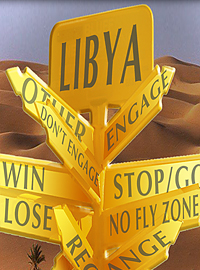
For the first time, Obama is the Commander-in-Chief of a war that he authored rather than inherited. And the man who a decade ago anointed himself the arbiter of intelligent warfare is leading the U.S. into a conflict that is questionable on its merits and incoherent in its execution.
|
|
| “I don’t oppose all wars … what I am opposed to is a dumb war.” – Barack Obama, 2002
Oh how luxurious the view from the cheap seats must seem to Barack Obama in retrospect. The man who spent the past decade (beginning with the now famous speech quoted above) trying to decide whether he was more preternaturally suited for the role of President of the United States or philosopher laureate (and ended up concluding that the roles weren’t mutually exclusive) is now in the big chair. He is no longer leading the faculty seminar on war and peace. He’s dictating the source material.
Despite being a wartime president from the inception of his administration, this is something of a new role for Obama. By the time he took in office in January 2009, the war in Iraq was winding down, thanks largely to the political boldness of President George W. Bush, the strategic insights of General David Petraeus and the success of the “surge” strategy that Obama had opposed as a member of the United States Senate.
Likewise, the war in Afghanistan – which Obama repeatedly used on the stump as a moral foil for the “bad war” in Iraq – has not played a dominant role in his presidency. True, there was his own surge announced late in 2009. But the bump in troop levels was accompanied by a timeline for withdrawals and a subsequent silence that indicated that the war that was the most immediate consequence of 9/11 was not a serious priority for our 44th president.
Now comes the military action in Libya, led by an international coalition that relies on the United States for the lion’s share of its power projection. For the first time, Obama is the Commander-in-Chief of a war that he authored rather than inherited. And the man who a decade ago anointed himself the arbiter of intelligent warfare is leading the U.S. into a conflict that is questionable on its merits and incoherent in its execution.
Begin with the basics. There’s no question that Libyan dictator Muammar Gaddafi is a depraved tyrant who has sponsored terrorism abroad and shown no respect for basic human rights at home. He is joined in the ignominy of repression, however, by a rogue’s gallery of world leaders that includes Kim Jong-il, Hugo Chavez, Bashar al-Assad, Mahmoud Ahmadinejad and Robert Mugabe – none of whom the nation is at war with. It would seem to follow then, that a more direct American national security interest is in play. But the reality tells a different story.
Consider Obama’s war in comparison to the conflicts engaged in by the Bush Administration: Afghanistan is almost universally accepted as a war of necessity, precipitated by the Taliban regime’s material support of Al Qaeda and Osama Bin Laden. While the prime rationale for the war in Iraq – that Saddam Hussein possessed weapons of mass destruction he was willing to use – proved to be false, it represented a clear American national security interest. Though the faulty intelligence had deleterious consequences, the inaccuracy of the WMD claims was an honest mistake rather than a craven deception, and the one man who could have corrected the record in time – Saddam himself – chose not to.
What’s the corresponding national security interest in Libya? The only claim that’s carried even slight purchase thus far is the cynical notion that this is yet another war for oil. But people who understand the region know that stability – whether in the form of a democrat or a tyrant – is the key to maintaining energy supplies. Given that Gaddafi was on his way to putting down the rebellion, western inaction would have been the best policy if the only intent was to keep oil prices down.
Stability, however, is the last thing this war can be counted on to deliver. Members of the international alliance can’t generate agreement on whether a goal of the mission is to remove Gaddafi from power – and since an intact Gaddafi is unlikely to become a benevolent liberal anytime soon, the conflict’s very purpose is thus called into question. In addition, the mission suffers from an unintelligible chain of command, with the most recent suggestion being that a multinational “political steering committee” takes charge, making this perhaps the first war ever organized along the lines of a non-profit organization.
Finally, there’s the incidental matter of constitutional authority. Unlike the supposedly reckless Bush, who secured congressional approval of action in both Afghanistan and Iraq, Obama didn’t breathe a word to the legislative branch over Libya. Perhaps that’s because – as former Secretary of Defense Donald Rumsfeld posited earlier this week – the adventure in Libya was so ill-defined that the Administration couldn’t go to Congress because “they didn’t know what to ask for.”
This president is famously proficient when it comes to the power of words. Perhaps he can use that skill to explain what separates a “dumb war” from a war with an unclear justification and an incompetent plan of action. We’re waiting.
|