|
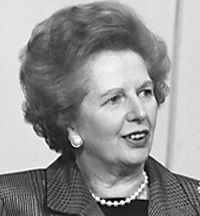
In an environment of huge government growth, economic stagnation and weakness abroad, [Margaret Thatcher] had the courage to advocate for free-market economics, a robust national defense and personal freedom – and the political skills to deliver on these promises. ... Though the decision is still years off, Americans would do well to begin asking themselves who among us passes the Thatcher test.
|
|
| “Democracy is the theory that the common people know what they want and deserve to get it, good and hard.” That was the verdict of H.L. Mencken, the Baltimore wag who many consider one of the greatest journalists of the early 20th century. That his judgment stands up nearly a hundred years later goes to prove that he probably deserves the title.
Only slightly more conciliatory in his judgment was Winston Churchill, who famously remarked, “democracy is the worst form of government except all those other forms that have been tried from time to time.” While the eye Churchill turned towards the masses may not have been as jaundiced as Mencken’s, the greatest statesman of the 20th century would taste the fruits of his judgment in a way the acerbic newspaper columnist never would.
Less than two months after the Allied victory in Europe that he had helped midwife, Churchill lost his prime ministership. What came afterwards was an ironic vindication of his earlier criticism of popular democracy. Having narrowly avoided violent extermination, Britain chose a path of slow impalement.
In the reign of Clement Attlee – the Prime Minister who followed Churchill – the United Kingdom affirmatively opted for civilizational decline.
Rather than harnessing the creative powers of the free market to create a new age of British prosperity, Attlee’s Labour government seized the means of production and dramatically redistributed wealth. It created the National Health Service, Britain’s system of socialized medicine. It nationalized the “commanding heights” of the British economy, putting industries from banking and railroads to airlines and coalmines under government control. And, at precisely the moment that the U.K. cried out for economic recovery, it destroyed the value of the British Pound and caused widespread shortages of food and energy.
Under Attlee, the British government also launched a controlled demolition of its role as a world power. It began divesting itself of its colonial holdings, sparking massive bloodshed on the Indian subcontinent (and starting a trend of imperial flight that would eventually lead to decades of military dictatorships and mass atrocities in Africa). And it began a slow fade into second-class status as the United States and the Soviet Union became the dominant players in international affairs.
Yet amongst this decline, there was a glimmer of hope. As if to verify Churchill’s sliver of optimism, British democracy would go on to show its resilience in 1979 – revealing (as Churchill’s ascension to the prime ministership nearly 40 years before had) that the popular rabble could become remarkably responsible in times of crisis. This time around, the kingdom’s savior would take the shape of a 53-year old chemist from Grantham – a woman by the name of Margaret Thatcher.
When Thatcher became prime minister, she inherited a country in deep disquiet. Runaway inflation, rampant unemployment, and staggering union power were enervating the economy. Britain’s ability to project power was typically seen as either weak or non-existent. And national morale had cratered.
Thatcher filled the breach with gusto. She tightened the money supply to wring inflation out of the system. She enacted a series of reforms to weaken the special privileges that the unions had won over the years. She privatized sectors of the British economy that had been under state control since Attlee’s day. And through a defiant anti-communism that she shared with President Ronald Reagan (and a willingness to exercise power best demonstrated by the Falklands War), she helped her country rediscover its national nerve.
Yes, democracy has its flaws. In times of perceived comfort, the Clement Attlees of the world can occasionally seduce the masses. But for every Attlee there is a Margaret Thatcher.
For Americans who think that Barack Obama is Attlee’s American successor, this is a good time to consider the lessons of the Iron Lady. In an environment of huge government growth, economic stagnation and weakness abroad, she had the courage to advocate for free-market economics, a robust national defense and personal freedom – and the political skills to deliver on these promises. Those are two traits that don’t often intersect – but America’s next leader will need both. Though the decision is still years off, Americans would do well to begin asking themselves who among us passes the Thatcher test.
|