




|
|
|


| Cash for Cluelessness |
 |
|
By Troy Senik
Wednesday, August 05 2009 |
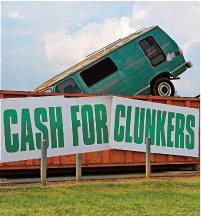
This just in from Washington: people like free money. That’s the realization that dawned on the nation’s capital last week when it was announced that the federal government’s “Cash for Clunkers” program had taken only one week to run out of $1 billion in funds that were intended to be stretched over three months. How Congress didn’t see it coming boggles the imagination. But when you’re intellectually unengaged, the learning curve is vertical. The Obama Administration and its amen corner in the newsrooms of New York and Washington are hailing the program, which provides tax credits of up to $4,500 to consumers who turn in an old car for a more fuel-efficient model, as an unalloyed success. And in the wake of its financial exhaustion, they are now lobbying hard for the U.S. Senate to go along with the House’s appropriation of another $2 billion in funds to keep the program clunking along. Before the world’s greatest deliberative body unthinkingly dips back into the till, however, they should pause to consider the divergence between the program’s hype and its realities. It’s true enough that “Cash for Clunkers” led to a spike in auto sales in late July. Ford reported its first monthly sales increase in the U.S. in more than a year and a half. Hyundai, a leading manufacturer of fuel-efficient models, saw its sales up 12 percent over the previous July. But privileging concentrated benefits over diffuse and delayed costs, while politically expedient, is a recipe for economic delusion. For starters, it’s fanciful to believe that the concentrated shock of cash for clunkers represents anything like a template for a healthy automobile industry. Getting hit with a defibrillator a few times is not the same as passing a physical. Sure, the good times can keep rolling if Congress is willing to subsidize car dealerships in perpetuity, but that’s not a viable business model. It’s a lobbying strategy. In reality, this program is little more than corporate welfare with a soft candy center. Dealers may love the added traffic on their lots and buyers may delight at how much cheaper that new car smell comes these days. But every American who is not a part of that binary equation is left holding the bag for what will probably amount to $3 billion in new debt. That the Obama Administration has correctly calculated that the public has grown numb to the number of zeroes that follow the dollar sign says less about the White House than it does about the body politic. On top of the morally dubious (and economically suspect) argument that the federal government should be fattening the bottom line for preferred industries at taxpayer expense while others languish, the program comes with a raft of unintended consequences. In order to shift America’s auto fleet towards greater fuel efficiency, “Cash for Clunkers” mandates the destruction of the less efficient vehicles that consumers turn in. The obvious effect will be a reduction of supply in the market for used cars, driving up costs for the poor and the financially prudent, as well as cutting decisively against new drivers, most of whom don’t have the option of turning in their current car because they don’t own one. The program also attempts to get around arbitrage by requiring consumers turning in their gas-guzzlers to show proof of insurance and registration for the car over a period of at least a year prior to the trade-in. But with markets always more creative than government lawyers, no one seems to have factored in that plenty of arrangements for compensation can be worked out without transferring a vehicle’s title. Apart from its economic effects, “Cash for Clunkers” has also been sold as a step towards greater environmental protection, but that claim is highly suspect. Greater fuel efficiency has the economic effect of lowering the price per mile traveled, meaning that it often encourages drivers to travel more. As for reducing America’s reliance on foreign oil, even if one accepts the Alliance for Automobile Manufacturers’ optimistic prediction that “Cash for Clunkers” will reduce America’s fuel consumption by 58 million gallons of gasoline a year, grandiose claims of “energy independence” can’t be sustained. 58 million gallons is just under three million barrels of crude oil – or less than a third of what America imports every day. Perhaps the worst aspect of “Cash for Clunkers”, however, is that it continues the political class’s denial of reality in light of the financial crisis. In the midst of an economic downturn that was promoted by easy money, excess debt and feverish consumption, most of the government’s solutions revolve around … well, easy money, excess debt and feverish consumption. Propping up auto companies and subsidizing Americans who take out new loans is curious behavior for a President who said in his inaugural address that “our time … of protecting narrow interests and putting off unpleasant decisions … has surely passed.” But it seems as if the President finds his decision-making much less onerous when someone else is footing the bill. |
Related Articles : |
