|
As a cavalcade of commentators made the rout seem routine – and papered over the fact that they were declaring the Republican Party dead just two years prior – several meaningful trends got lost in the shuffle.
|
|
| By the time the midterm elections began to wrap up on Tuesday night, the entire affair was beginning to seem like old hat, especially to the reporters who had been monitoring the 2010 races for over a year. Saturation coverage was so ubiquitous that even the most historic outcomes of the race were treated as tired clichés.
Yes, Republicans had claimed over 60 seats (a net gain bigger than any since FDR’s Democrats lost 71 in 1938), but a few particularly jaded pundits wondered whether that constituted “a wave” when the most wall-eyed predictions had run near the triple digits. Yes, the public was united like never before in opposition to bigger government, but would they really be willing to make the sacrifices that goal entails? Yes, President Obama had been decisively refuted at the ballot box, but was that really so different from the midterm setbacks suffered by Presidents Reagan and Clinton in their first terms? By the time election night was over, it was clear that the professional commentariat was nearly as listless and cynical as the politicians being sent packing.
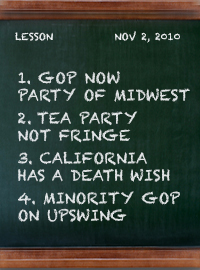
As a cavalcade of commentators made the rout seem routine – and papered over the fact that they were declaring the Republican Party dead just two years prior – several meaningful trends got lost in the shuffle. Thus it bears noting four of the most interesting results of 2010:
1. Republicans Are Now the Party of the Midwest -- With few exceptions, the nation’s political geography has been a relatively routine affair over the last decade or so. The West Coast and the Northeast are consistent liberal bastions (Republicans were virtually wiped out north of the Potomac River in the past few cycles). The South and the Mountain West tend to be solid for Republicans. The Midwest, however, is a more complicated affair, with cultural conservatism often prevailing in the Plains and blue-collar Democrats giving the left a boost along the Great Lakes.
2010, however, brought shocking Republican gains throughout the region. The GOP won governor’s races in South Dakota, Nebraska, Kansas, Wisconsin, Iowa, Michigan and Ohio (the latter five all taken from Democratic hands). At press time, governor’s races in Minnesota and Illinois are both still too close to call, itself an accomplishment.
In the Senate, Republicans held onto seats in South Dakota, Kansas, Missouri, Iowa and Ohio while picking up seats in North Dakota, Wisconsin, Illinois, and Indiana – leaving them with a perfect record in the region. In the Midwest’s state legislatures, Democratic ranks were reduced to 38 percent, the lowest proportion since 1956.
The Midwest is traditionally the pivot on which presidential elections turn, meaning Tuesday night’s results cast a long shadow over dreams of reelection in the Obama White House.
2. The Tea Party Movement Isn’t as Fringe as its Opponents Suggest, Nor as Invincible as its Supporters Wish -- Despite all the hype on both sides, it turns out the Tea Party Movement’s performance at the ballot box looks a lot like those of other (successful) political movements.
In the U.S. Senate races – where the Tea Party’s involvement was most noticeable – they won big with Marco Rubio in Florida, Rand Paul in Kentucky, Pat Toomey in Pennsylvania and Ron Johnson in Wisconsin. They weren’t as fortunate with Ken Buck in Colorado, Sharron Angle in Nevada, Christine O’Donnell in Delaware, or, by early indications, Joe Miller in Alaska. The unmistakable lesson? The Tea Party’s message of smaller, smarter constitutional government is a winner … but not one so powerful that it can overcome the vagaries of flawed candidates.
3. California Has a Death Wish -- No state is more in need of a Tea Party-style shakeup than Greece on the Pacific. Apparently, none is also in as deep a state of denial.
With annual deficits in the tens of billions, the nation’s third highest unemployment rate and outstanding public pension liabilities of over $500 billion dollars, California doubled down on liberalism. Not only did they send Barbara Boxer back to the U.S. Senate for a fourth term (grounds for collective punishment if ever there was one) and reinstall “Moonbeam” Jerry Brown in the governor’s mansion; they also handed every statewide office to Democrats (though the Golden State’s Attorney General race is still too close to call) and defeated a ballot initiative that would have suspended California’s new global warming law (estimated to destroy 1.1. million jobs) until the state’s unemployment rate drops to 5.5 percent or lower for four consecutive quarters.
About the only place where California resisted down-the-line liberalism was in rejecting Proposition 19, which would have legalized the recreational use of marijuana. Had they known the rest of the night’s outcomes in advance, California conservatives may have voted differently on the right to self-medicate.
4. Minority Republicans are on the Upswing -- For all the talk of last minute get-out-the-vote efforts by Democrats in minority communities, Republicans posted impressive gains with minority candidates. The party elected three Hispanic candidates with the potential to be national figures: Marco Rubio to the U.S. Senate in Florida, Susana Martinez to the governor’s mansion in New Mexico and Brian Sandoval to the governor’s mansion in Nevada. In addition, five Hispanic Republicans won house races (two in Texas, and one each in Idaho, Washington and Florida), creating the greatest number of Hispanic congressional Republicans in history.
The gains didn’t end in the Hispanic community. For the first time in over a decade, two black Republicans will serve simultaneously in the House, with the elections of Allen West in Florida and Tim Scott in South Carolina. The Palmetto State also elevated Nikki Haley to the governor’s office, making her the second Indian-American chief executive in the nation, alongside fellow Republican Bobby Jindal of Louisiana.
|






