|
For those of us with warmer blood coursing through our veins, the plan’s willingness to use the military as a pawn is reprehensible.
|
|
| For all of the drama that accompanied this summer’s deal to increase the national debt ceiling, the entire affair ended up playing out more or less as business as usual – at least by the standards of Obama-era Washington. That meant an agreement was only secured at the last minute, with the corresponding legislation rushed through too quickly for the American people to understand its implications prior to passage.
With the debt ceiling having failed to facilitate a “grand bargain” that would ameliorate the nation’s crisis of overspending, the governing class punted, forming a 12-member bipartisan, bicameral “supercommittee” tasked with finding $1.2 trillion in savings over the course of a decade (and doing so by November 23).
The supercommittee is, in and of itself, an admission of defeat, resting on the notion that Congress is incapable of meaningful action (so much so that the committee’s recommendations will not be subject to amendment by outside members). But it’s also an example of why the Obama Administration’s practice of ramming bills through the legislative chamber at the eleventh hour is so dangerous.
Though little remarked upon in the press, the consequences if the supercommittee fails to reach agreement are ominous. As noted in a recent report by the Foreign Policy Initiative:
“If this bill doesn’t become law by mid-January 2012, then the debt-limit deal’s so-called “trigger” provision will automatically reduce defense spending in not just one, but two ways. First, it will establish new long-term caps to limit discretionary spending that will cut over $550 billion from what the Pentagon (based on Obama’s fiscal year 2012 budget proposal) was projected to spend in the next ten years. Second, the trigger provision’s multi-year “sequestration” cuts will further slash roughly $600 billion more in the worst-case scenario. In all, the trigger provision could effectively cut anywhere from $575 billion to over $1 trillion from projected defense spending over the next decade.”
Those cuts will be in addition to the 10-year, $350 billion reduction in the Pentagon’s budget that was included in the original debt deal.
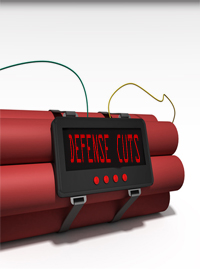
This is a cunning bit of gamesmanship on behalf of the administration. By getting members of Congress to make the tough decisions about fiscal prudence, the White House will be able to keep its fingerprints off of any measures that impose politically unpopular austerity. And by holding the men and women of the United States military hostage, it has created a daunting incentive for the members of the supercommittee to act. As a bit of Machiavellian strategy, it’s enviable. But for those of us with warmer blood coursing through our veins, the plan’s willingness to use the military as a pawn is reprehensible.
It’s not, of course, that the Pentagon doesn’t deserve the same amount of scrutiny as any other organ of the federal government when it comes to stewarding taxpayer money. Defense secretaries of both parties, for instance, have long lamented the cost overruns and waste rampant in the Defense Department’s contracting processes. But national security is the first and highest priority of the federal government. Why it should face such heavy cuts when Washington is doling out half a billion dollars in loan guarantees to a solar power company or cutting $125 billion worth of checks paid in error (according to the Treasury Department’s annual Financial Report of the United States Government) defies understanding.
Make no mistake: These cuts will not be cosmetic. As George Will wrote in a recent column, “The cuts would leave the smallest Army and Marine Corps in more than a decade and the smallest tactical Air Force since this service became independent of the Army in 1947.” Congressman Buck McKeon of California – Chairman of the House Armed Services Committee – told an audience at the American Enterprise Institute earlier this month, “A Marine general recently testified in front of my committee that if America had another military emergency, they could only respond to the Central Command area of operations. That’s it. In short, if something happened in the Pacific, don’t bother calling the Marines.”
As members of Congress spend the coming months debating the vital need for getting federal spending under control, we’ll be subjected to the phrase “all options are on the table” ad nauseam. If that cliché proves true, it will illustrate a profound lack of discernment. The table shouldn’t be wide enough for any option that leaves the most powerful fighting force in world history stuck with the motto “Don’t bother calling the Marines.”
|