























| Is Cain Able? |
 |
|
By Quin Hillyer
Monday, October 03 2011 |
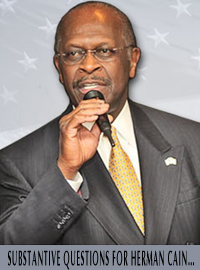
I am an unabashed fan of Herman Cain, and have been a fan ever since he schooled Bill Clinton in 1994 in a town meeting on Hillarycare. I have consistently given Cain high marks for his debate performances. I am glad he is rising in the polls. I think he is terrific on economics and most domestic policy. Now comes the serious vetting, though. Conservatives should ask Cain a number of questions -- not as "gotcha" questions, because he probably has good answers, but as serious, substantive queries: 1) How does your 9-9-9 tax plan add up in terms of federal revenues? How can it possibly be revenue neutral if it effectively takes nine percent of the economy while the historical average for federal revenues is 18 percent? Sure, we like lower taxes, and we believe that in some cases lower taxes can still produce equivalent (or, rarely, greater) revenues -- but we would like to see the "scoring" analysis, dynamic as it certainly will be. If we are worried about exploding debt, we can certainly accept the idea that we can cut spending over time to stop adding to debt – but that doesn't mean we don't need at least to maintain current revenues (again, not rates, which can go down, but revenues)… does it? 2) You have said about the Federal Reserve that we shouldn't end it, but mend it. How? What should be mended? With which of its policy or financial choices do you disagree? And what did you learn from your service as chairman of the Kansas City Fed? How would that experience help you as president? (I would think it would be of great help; this is a softball question aimed at giving you a chance to build a narrative that highlights your experience.) 3) Back to 9-9-9: You have said that none of the 9s would rise over time. Why not? How will you guarantee this? Will you try to somehow cap one or more of the 9s? If so, how? Statutorily? Through a constitutional amendment? And what would happen to states and especially localities that now rely heavily on the sales tax as the only source of revenue that the feds so far have left entirely to state and local use? If the feds add a 9 cent sales tax on top of a 6 or 7 cent state and local sales tax, will that 15 or 16 percent level provide impetus for a counterproductive black market to grow, considering that such "off-the-books" exchanges almost always tend to spring up when sales or excise taxes get too high? If so, how would you combat that black market? 4) How does your business experience translate into political life? (Some business experience does so; some doesn't.) Practical politics, unlike some businesses, isn't merely about commands carried out by underlings; it is largely about successful negotiations carried out in large part in the public eye. Did your business background give you negotiating skills? When and where and how? In what other ways have you developed a skill set specifically applicable to governing? Have you been involved in organizations where the structure isn't entirely vertical but at least largely horizontal, with competing realms of power? 5) You have acknowledged having very little experience with foreign or military affairs, but said you would surround yourself with the right experts and apply certain principles (such as "if you're in it, win it"). In that spirit, who are the foreign and defense experts or practitioners, past or present – not including Ronald Reagan, because that answer is too easy – whom you have most admired? (This is NOT to ask whom you would hire as president, but rather whose work you would use as a model or guide.) Why have you admired them? 6) Many presidential candidates arrange for advisory boards of policy experts and make those names public. Have you started consulting with experts on foreign and defense policy yet, and if so, who are they? 7) Name three current federal judges, excluding the Supreme Court, about whom you think most highly. Why? Who are the people you turn to (again, not whom you would hire, but who you trust to give you good advice) for advice on matters constitutional or broadly legal? 8) Despite the facile labels, not all “conservative” judges approach the law the same way. Acknowledging that they think alike much of the time, it is still rather easy to distinguish, for instance, Clarence Thomas' approach from Antonin Scalia's. In those areas where they do differ, are you a Thomas guy or a Scalia guy – and why? There – that should be enough for now. Answer these questions well, and a lot of conservatives may flock to you in droves. |
Related Articles : |
