




|
|
|
















| A Tale of Two California Cities Provides Bellwether for Golden State’s Future |
 |
|
By Ashton Ellis
Thursday, July 22 2010 |
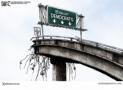
California’s intensifying economic tremors are widening the divide between two approaches to government: retrofitters and façades. With the fiscal “big one” likely to strike all levels of the state’s administration in the next year, each response will be judged by how well it braces for the coming seismic collapse of public finances. For “retrofitters” like the City of Maywood, it is the worst of times. Southeast of Los Angeles, Maywood encompasses 1.14 square miles. Most of its 45,000 residents are working class Hispanics. And like a number of California communities, the city is facing a severe budget deficit. After receiving a cancellation notice from the California Joint Powers Insurance Authority (CJPIA), the agency which provides liability insurance to most cities in the state, Maywood city council members took an unprecedented step to reinforce its fiscal integrity. It fired almost all of its city workers, including the police department. According to the city council, the police department made the mass layoffs inevitable. Unlike many California municipalities, Maywood’s economic woes aren’t primarily related to reductions in property and sales tax revenues, although the drops haven’t helped. Instead, Maywood’s fiscal calamity is tied directly to the corruption of its police force. In a report issued last year, the state attorney general summarized the department’s culture as “one permeated with sexual innuendo, harassment, vulgarity, discourtesy to members of the public as well as among officers, and a lack of cultural, racial and ethnic sensitivity and respect.” That culture of corruption put Maywood taxpayers on the hook for $19 million in current judgments against the police department. When the CJPIA announced it would no longer insure the city because of the police officers’ conduct, the city council decided to become the first California city to contract for all of its city services, effective July 1. Patrols are now conducted by the Los Angeles Sheriff’s Department for half the $8 million a year demanded by Maywood police. Many of the city employees laid off have been rehired on independent contracts at one-fourth the cost. Already, Maywood residents report a major improvement: increased responsiveness from police and city workers. “We don’t want to be the model for other cities to lay off their employees,” says Magdalena Prado, a Maywood spokeswoman working on contract. “But our residents have been somewhat pleased.” The same can’t be said for residents of the City of Bell, the neighbor Maywood is paying to provide every public service except police. Unlike the retrofitters in Maywood, Bell city officials are enhancing the façade of government instead of strengthening its core. In fact, the only similarities between Bell and Maywood are their sizes and demographics. Bell is barely more than 1 square mile with a population close to 40,000. Bell claims per capita income of $24,800 as of its 2008 financial statements – a number substantially lower than the $32,819 national average for 2009 reported by the U.S. Bureau of Economic Analysis. Yet that meager per resident income hasn’t stopped Bell city officials from enjoying the best of times when it comes to deciding their own compensation. In a report released this week, it was revealed that the city manager makes $787,637 a year, plus annual 12 per cent raises. The police chief makes $457,000 a year, or the equivalent of what he made in retirement plus the $165,000 he would make as police chief. Put another way, the Bell police chief serving 40,000 makes more money than the Los Angeles police chief serving 3.8 million. Then there’s the part-time Bell city council members making close to $100,000 a year. To compare, Maywood’s part-time city council gets $347 every two weeks. Part of what makes the Bell salaries possible is a provision in California law that allows cities to opt out of compensation caps passed by the state legislature. Shortly after a law limited part-time city council members to a few hundred dollars compensation a month, the Bell city council voted to operate under its own charter and set its own pay schedule. Are Bell residents at least getting a good return on their investment? Hardly. After approving $50 million in bonds over the last six years, Bell taxpayers saw new parks, cleaner streets and better lighting. Then they got the bill. The per capita debt rose from $599 in 2004 to $1,972 in 2009. No façade, no matter how new or well lit, justifies that kind of debt. Next Monday, July 26, the Bell city council reconvenes for a special open hearing to discuss city officials’ compensation. You can bet the public testimony portion won’t be pretty, nor should it be. With the state budget deficit at least $15 billion and certain to grow, governments up and down California’s public administration food chain should learn the lessons of the Maywood and Bell experiences. Outsourcing services is a viable, sustainable option. Obscene compensation for so-called public servants is not. |

Related Articles : |
