























| Why Liberals Can’t Win a Serious Tax Debate |
 |
|
By Ashton Ellis
Thursday, April 12 2012 |
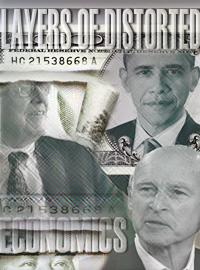
In California, Governor Jerry Brown is pushing for a “Millionaire’s Tax” that hits people earning well below that threshold. President Barack Obama is stumping across the nation for a “Buffett Rule” that raises taxes but makes no impact on the deficit. Both are showcasing why liberals can’t win a serious tax debate on the merits. With California facing a multi-billion budget deficit next year, Governor Jerry Brown has been trying to push unions and other liberal groups into coalescing around a single ballot initiative that would raise taxes on the state’s wealthiest citizens. The problem for Brown is that the Millionaire’s Tax initiative compromise he hammered out with the California Federation of Teachers and others would apply to incomes starting at $250,000. When asked by reporters how he can justify championing a tax increase on the wealthy that actually hits middle class small business owners, Brown stepped back into his “Governor Moonbeam” days and said, “Anybody who makes $250,000 [a year] becomes a millionaire very quickly, if you save.” How quickly? “Four years,” said California’s financially challenged chief executive. Whatever his shortcomings as an accountant, Brown is a savvy pol. He knows that polls indicate strong support for taxing “the rich.” Sticking it to millionaires has a nice ring to liberal ears. But Brown also knows that being honest about who will actually pay for his tax increase is a political loser. Overwhelming opposition to tax increases has characterized California’s voters since the state began a nationwide taxpayers’ revolt in 1978 with Proposition 13, which imposed severe limits on raising taxes. There remains significant resistance to tax hikes among Californians today, even as voters continue to approve costly spending measures. Brown knows this. That’s why he’s trying to sell a tax increase on middle class incomes as purely a tax on millionaires. In reality, his Millionaire’s Tax is a tax on millionaires and everyone earning 75 percent less than a million dollars per year. Faced with a choice between losing with the truth or winning through deception, Brown is opting to mislead the public about the application of his Millionaire’s Tax so that he and his fellow liberals can keep spending other people’s money. But whereas Brown’s millionaire misnomer sacrifices honesty for the sake of revenue, President Barack Obama is doing the opposite with his so-called “Buffett Rule.” According to the President, it isn’t “fair” that people earning a million dollars or more per year are able to pay a lower tax rate on their investment income than those who earn less in straight salary but pay higher income tax rates. Billionaire investor Warren Buffett popularized this argument last year when he claimed he pays a lower percentage in taxes on investment income than his secretary does on her salary. The problem with Buffett’s argument is that it’s disingenuous. As an investor, he’s already paid taxes on any income he received as salary. Taxes then paid on investment income (after first paying taxes on it as salary) are taxes on the same corpus of money. In that scenario, Buffett is being taxed on salary the same as (and probably more than) his secretary, and then paying an additional tax on his investment income. On the other hand, Buffett may be complaining that he was compensated with salary shielded from income taxes and put into an investment account that yields income. If that’s true, then he probably does pay a lower tax rate than his secretary, but only because he wants to. To correct this alleged injustice, all the Oracle of Omaha needs to do is change his compensation to salary. Otherwise, cut a check to the government and stop complaining. None of this matters to Senate Democrats who have scheduled a vote next Monday to make sure people who are barely millionaires – let alone multi-billionaires like Buffett – are required to pay a minimum income tax. The “Paying Our Fair Share Act,” the Senate Democrats’ version of the Buffett Rule, would mandate a minimum 30 percent tax rate on adjusted gross income exceeding $2 million annually, with households earning between $1 million and $2 million paying part of the taxes required to reach the 30 percent threshold. The purpose of the vote is to embarrass fiscally conservative Republicans who refuse to endorse a tax increase by framing them as defenders of the rich. The real embarrassment, however, should be on the liberals in the Senate and the Obama White House for wasting time on a gimmick that - even if passed - won’t make a dent in the deficit. The Joint Committee on Taxation estimates that the Senate Democrats’ bill will raise only about $47 billion over 10 years, or less than $5 billion a year, assuming the Bush tax cuts expire. To put that into perspective, the U.S. budget deficit has topped $1 trillion dollars every year under President Obama. The reason Obama’s Buffett Rule raises so little money relative to the overall budget deficit is because the rule is intended to impose extra taxes on only a few hundred wealthy taxpayers. According to a White House factsheet, “Of the 400 highest income Americans, one out of every three in this group [i.e. 130-135 households nationwide] of the most financially fortunate Americans paid less than 15 percent of their income in income taxes in 2008. …[I]t is these high-income taxpayers that the Buffett Rule is meant to address.” Obama isn’t doing this because he thinks it’s a good financial solution to the deficit problem. He’s doing it because he thinks the government has a moral responsibility to redistribute wealth. Remember, it’s the Buffet Rule, not the Buffett Rate. Serious tax reforms are both logical and productive. Jerry Brown’s Millionaire’s Tax isn’t logical because it applies to families and small businesses earning $250,000 annually in one of the highest cost-of-living states in the nation. That’s why he’s misleading. Barack Obama’s Buffett Rule isn’t productive because it raises no more than a rounding error relative to his federal budget deficit. That’s why he’s posturing. Liberals know they can’t win a tax debate on the merits, so they mislead, distort and confuse. That’s how they govern. |
Related Articles : |
