




|
|
|






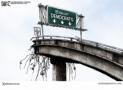
| As Our Economy Continues to Stagnate, the U.S. Falls Again in Annual Index of Economic Freedom |
 |
|
By Timothy H. Lee
Thursday, February 04 2016 |
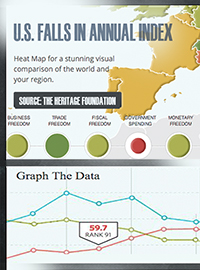
Last week, the U.S. Commerce Department announced that our economy grew just 0.7% in the final quarter of 2015. Days later, the annual Wall Street Journal/Heritage Foundation Index of Economic Freedom revealed that our standing once again declined last year. Adding particular poignancy is the way in which those two measures tragically interrelate over the past decade. Specifically, the Commerce Department announcement means that America's economy grew just 2.4% for the year 2015, the tenth straight year that we've grown less than 3%. To put that into proper perspective, the U.S. hasn't gone an entire decade without growth above 3% since the Great Depression. Providing additional context, we've averaged 3.3% annual economic growth since World War II. Additionally, a post-recession recovery period traditionally witnesses stronger-than-average growth rates, not weaker-than-average rates. Yet since the last recession officially ended in June 2009, we've averaged just 2.1% growth. During that period we also witnessed unemployment above 8% for the longest continuous stretch since the federal government began keeping records, even though the Obama Administration promised that unemployment wouldn't rise above 8% at all if his trillion-dollar "stimulus" passed. And for the first time in recorded history, median incomes actually declined rather than improved during the past six years of post-recession "recovery." Our labor participation rate, which measures the percentage of the total American population that is working, has also plummeted to lows not seen since the mid-1970s when women hadn't fully entered the workforce. Income inequality has also widened, even as liberals attempt to exploit it for political purposes. Anyone attempting to locate the cause of our decade of stagnation needn't search far. The annual Index of Economic Freedom identifies the obvious cause. Each year, the Index ranks the world's nations on a 0 to 100 scale using the following ten criteria: (1) business freedom, (2) trade freedom, (3) fiscal freedom, (4) government spending, (5) monetary freedom, (6) investment freedom, (7) financial freedom, (8) property rights, (9) freedom from corruption and (10) labor freedom. Based upon their total scores, nations are then categorized as either (1) "free," (2) "mostly free," (3) "moderately free," (4) "mostly unfree" or (5) "repressed." Two years ago, the U.S. fell from the world's top ten most economically free nations in the world for the first time in history. Today, the U.S. has tied its worst score ever, we remain outside the top ten and we qualify only as "mostly free" rather than fully "free." Making matters worse in our globally competitive economy, 32 nations now enjoy their highest-ever levels of economic freedom, and 97 of the 186 ranked countries improved their freedom scores from last year to this year. In contrast, the Obama years have taken us to unprecedented lows. Record levels of government spending, national debt, federal regulation, taxpayer subsidies and takeovers of such industries as healthcare and energy predictably account for our long-term decline. It's also worth noting that the U.S. now trails nations like New Zealand (3rd place), Switzerland (4th place), Australia (5th place) and Canada (6th place). Even reputed socialist paradise Denmark trails the U.S. by only one place at 12th. Accordingly, the next time you hear Bernie Sanders or one of his supporters praise the allegedly superior socialist model of Denmark as a template for U.S. recovery, recall its actual relative ranking above us in the Index. As demonstrated statistically by the Index, greater economic freedom leads to greater economic prosperity while less economic freedom leads to economic stagnation, wage stagnation, unemployment, economic anxiety and ultimately political turmoil. Sound familiar? Unfortunately, rather than recognize the causal relationship between less economic freedom and our ongoing economic malaise, an alarmingly high number of Americans believe that the remedy lies in even more government regulation, taxation and redistribution. As the 2016 presidential race accelerates, it's therefore critical that we collectively digest the causal relationship between freedom and prosperity, lest we continue our ongoing, unnecessary and avoidable decline. |
Related Articles : |
