
















| 10 Years After Katrina, Failed Global Warming Prophecies Accumulate |
 |
|
By Timothy H. Lee
Thursday, August 27 2015 |
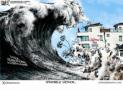
Like so much flotsam and jetsam, failed global warming prophecies accumulate a decade after Hurricane Katrina hit the Gulf Coast. Columnist George Will wryly recounts the words of Leon Trotsky biographer Isaac Deutscher, who solemnly said of Trotsky at an event that Will infiltrated as an Oxford student, "Proof of Trotsky's farsightedness is that none of his predictions have come true yet." Apparently, climate alarmists adhere to the same logic. One does not wish, of course, to treat a natural disaster that killed nearly 2,000 people with excess levity. Neither, however, should those within the lucrative global warming hysteria sector have attempted to exploit it for their own purposes. Most conspicuously, many immediately attributed causality to anthropogenic (man-made) global warming, and predicted the onset of a new era of more frequent events of similar magnitude. Time magazine offered a prototypical assessment before Katrina itself had even dissipated: "So is global warming making the problem worse? Superficially, the numbers say yes - or at least they seem to if you live in the U.S. From 1995 to 1999, a record 33 hurricanes struck the Atlantic basin, and that doesn't include 1992's horrific Hurricane Andrew, which clawed its way across south Florida in 1992, causing $27 billion dollars worth of damage. More-frequent hurricanes are part of most global warming models, and as mean temperatures rise worldwide, it's hard not to make a connection between the two." Nature spoke with even greater self-certainty several months after the disaster in March 2006: "Researchers at the Georgia Institute of Technology in Atlanta examined data for a range of climate variables thought to contribute to the formation of hurricanes in categories 4 and 5, the upper end of the strength scale. Only sea surface temperature showed a strong correlation with the observed increase in the occurrence of these storms since 1970. And with sea temperatures set to rise still further, that means the next few decades could bring even more hurricanes like Katrina, which hammered New Orleans in August 2005." And to everyone's surprise, noted stoic Al Gore spoke in uncharacteristically apocalyptic terms: "In the 1930s, Winston Churchill also wrote of those leaders who refused to acknowledge the clear and present danger. 'They go on in strange paradox, decided only to be undecided, resolved to be irresolute, adamant for drift, solid for fluidity, all powerful to be impotent. The era of procrastination, of half-measures, of soothing and baffling expedients, of delays, is coming to a close. In its place, we are entering a period of consequences.' With Hurricane Katrina, the melting of the Arctic ice cap and careless ecological mayhem, we, too, are entering a period of consequences. This is a moral moment. This is not ultimately about any scientific debate or political dialogue. Ultimately it is about who we are as human beings." In the ensuing decade, however, a strange thing has happened. Namely, in the ten years since Katrina, we have now witnessed the longest stretch in recorded history without a major-category hurricane in the U.S. Even Huffington Post was forced to confront that inconvenient truth in 2013, preposterously attributing it to "luck": "Surprisingly, not a single major hurricane, defined as a Category 3 storm or higher on the Saffir-Simpson scale - with minimum wind gusts of at least 111 mph (178 km/h) - has directly hit the United States in nearly eight years. That's twice as long as any major hurricane landfall 'drought' since 1915, and by far the longest on record since data began being collected prior to 1900. As of today (Sept. 12), it's been 2,880 days since Hurricane Wilma, the last major hurricane to strike the United States, made landfall on Oct. 24, 2005... Luck probably plays the biggest role in the lack of major hurricane hits, said Chris Landsea, the science and operations officer at the National Hurricane Center (NHC)." So let us get this straight. When Katrina hit, it was due to global warming and we could expect similar catastrophic hurricanes with even greater frequency in future years. But when none appeared for a record stretch, it was sheer luck. Undeterred by that recent record of inaccuracy, the year 2015 witnessed similar failed predictions. This past January, St. Lucia News reported that "Global Weather Oscillations Inc. (GWO), a leading hurricane cycle predictions company, says, 'The 2015 Atlantic Basin hurricane season will be the most active and dangerous in at least 3 years, and the next 3 seasons will be the most dangerous in 10 years." But fast-forward to this past week, when News Daytona Beach ran the headline "Hurricane Experts Downgrade 2015 Atlantic Forecast." "It's been a quiet hurricane season so far in the Atlantic Ocean," the story reported, "and some experts don't expect that to change anytime soon." More broadly, we're now a quarter-century into the era of global warming hysteria. In 1989, the San Jose Mercury-News announced that, "A senior environmental official at the United Nations, Noel Brown, says entire nations could be wiped off the face of the earth by rising sea levels if global warming is not reversed by the year 2000." We're still waiting, but the U.N.'s predictions continue unabated. Despite massive industrialization of China and India, and enormous amounts of carbon produced thereby, temperatures have plateaued since the 1990s and one catastrophic prediction after another has expired. That accumulation of failed predictions from global warming alarmists, including current White House occupant Barack Obama, should inversely reduce the certainty with which they continue to scold and predict doom. That it does not shouldn't dissuade the rest of the populace from assessing this "settled science" with the proper sobriety and historical context. |
Related Articles : |
