




|
|
|



| In the War on Terror, a Surrender |
 |
|
By Troy Senik
Thursday, June 06 2013 |
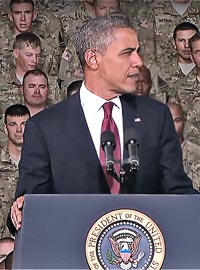
James Lileks, the great wag of Minnesota, recently opened his National Review column with an observation that deserves to be placed onto a plaque hung permanently in the Oval Office: “Second terms are the price a man pays for the hubris of thinking he deserves one.” Because Barack Obama’s supply of hubris is in surplus, it should come as no surprise that he’s now paying an extraordinarily high price. We all know the cliché: Presidencies fall apart in the second term. Nixon had Watergate. Reagan had Iran Contra. Clinton had the Lewinsky scandal and the subsequent impeachment. George W. Bush had the chaos in Iraq, which cleared up just in time for an economic disaster. Now Barack Obama has a scandal cocktail consisting of the deception surrounding last September’s terrorist attack in Benghazi; the IRS’s harassment of conservative non-profits, and the Justice Department’s surveillance of journalists. Obama may have thought he could stem the rise of the oceans, but he can’t resist the gravitational pull of a second term. There is a playbook for these sorts of travails. A president generally focuses on “getting back to work,” in an attempt to both distract attention from scandal and reassert his relevancy. Most often, this takes the form of a focus on foreign policy, an area where presidents are relatively free to work their will without the intrusion of a Congress that regards them as irrelevant once lame-duck status sets in. This was likely the motivation for Obama’s recent decision to give a major foreign policy address at the National Defense University in Washington D.C. Media coverage of the speech focused mostly on an extended exchange between Obama and a left-wing heckler over Guantanamo Bay, which buried the real story: Barack Obama has a plan for winning the War on Terror – he’ll simply say it’s over. During his remarks, Obama proposed repealing the authorization of military force that emerged from Congress in the aftermath of 9/11 – the document that provides the legal justification to pursue terrorists around the globe and, it should be noted, which allows for the drone strikes that the president spent much of his speech bending over backwards to defend. Now, Obama is far from the only person to take issue with the breadth of that authorization. Senator Rand Paul has also criticized the broad interpretation of the law, which has allowed the original post-9/11 mandate to extend to current conflicts with extremist groups (like those in Yemen and Somalia) that didn’t even exist at the time that Congress passed the bill. Fair enough. But apart from a vague assertion that “Our systematic effort to dismantle terrorist organizations must continue,” Obama didn’t offer any thoughts on what would replace the authorization of military force … which is important, because you can’t keep up that “systematic effort” without some legal authority. Instead, he offered a particularly listless bromide, noting that, “this war, like all wars, must end. That’s what history advises. That’s what our democracy demands.” Well, yes, but history also advises that wars don’t end because one side signs a piece of paper that the other ignores. It’s true, as Obama noted in his remarks, the scope of our war with Islamist terrorists has narrowed. We haven’t had anything remotely approaching another 9/11, thanks largely to the aggressive posture adopted in the wake of those attacks. But the threat has only been reduced because we’ve applied relentless pressure. Let up a little bit and you can be assured it will flare back up. That’s the thing about theocratic martyrs – they tend to define defeat differently than we do. A more sober president would have taken the reality as he found it – Al Qaeda weakened, but not defeated; Islamists still keen to strike the United States – and tailored a strategy accordingly. Obama, by contrast, believes that, since things are going our way, this is as good a time as any to call off the whole affair. This is what happens when a president is guided by that aforementioned hubris: He begins to believe that reality will take whatever form his speechwriters command. The task of combating radical Islam will be Obama’s for the rest of his term, whether he likes it or not. It will likely occupy several of his successors as well. The president can declare himself done with the War on Terror if he pleases. He just shouldn’t expect the War on Terror to return the favor. |
Related Articles : |
