




|
|
|















| Tom Cotton Schools Obama, Iran Leaders on the Constitution |
 |
|
By Ashton Ellis
Wednesday, March 11 2015 |
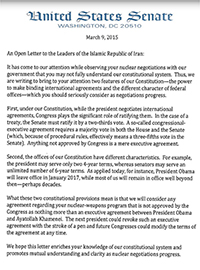
Senator Tom Cotton is out to teach the Iranian leadership a lesson about the U.S. Constitution, and is getting no help from the Obama administration. Earlier this week, Cotton wrote – and forty-six other Republican U.S. Senators signed – an open letter to the Iranian government explaining the short shelf life of any deal that allows them to develop a nuclear weapon without congressional approval. Here are the key passages from the letter: “It has come to our attention while observing your nuclear negotiations with our government that you may not fully understand our constitutional system. Thus, we are writing to bring to your attention two features of our Constitution – the power to make binding international agreements and the different character of federal offices – which you should seriously consider as negotiations progress. “…under our Constitution, while the president negotiates international agreements, Congress plays the significant role of ratifying them. In the case of a treaty, the Senate must ratify it by a two-thirds vote. A so-called congressional-executive agreement requires a majority vote in both the House and the Senate (which, because of procedural rules, effectively means a three-fifths vote in the Senate). Anything not approved by Congress is a mere executive agreement. “…President Obama will leave office in January 2017, while most of us will remain in office beyond then – perhaps decades. “What these two constitutional provisions mean is that we will consider any agreement regarding your nuclear-weapons program that is not approved by the Congress as nothing more than an executive agreement between President Obama and Ayatollah Khamenei. The next president could revoke such an executive agreement with the stroke of a pen and future Congresses could modify the terms of the agreement at any time.” All of this is true. Just like President Obama’s other unilateral executive actions – amnesty for illegal immigrants, unapproved carbon emissions standards and ammunition round-ups, among others – any decision of his that is not backed by congressional approval is subject to immediate termination once he leaves office. It’s the price of ruling via executive whim. When the executive changes, so does the policy. The logic and clarity of Cotton’s argument is so strong, the Obama administration and its allies refuse to debate the substance of it. Instead, they prefer to denigrate Cotton. Javad Zarif, Iran’s foreign minister, said, “This kind of communication is unprecedented and undiplomatic.” He likened it to a “propaganda campaign” that seeks to distort reality to serve an ideological outcome. Truth may be unwelcome in diplomacy, but it is necessary to secure a lasting agreement. As Cotton explained, “Many Iran experts will tell you that Iran’s leadership doesn’t fully understand our constitutional system. In fact, some of the president’s own senior aides have said that’s why the Congress shouldn’t pass conditional, prospective sanctions, or shouldn’t pass a bill requiring a review period, because Iran’s leaders wouldn’t understand it.” Iran’s foreign minister may prefer to negotiate within a context he’s comfortable with – a strongman leader whose authority comes not by consent but by personal will. But that’s not how America’s constitutional system works. Misunderstanding that reality now could lead to bitter reactions down the road. Unfortunately, Javad Zarif isn’t alone in his contempt for constitutional norms. U.S. Vice President Joseph Biden issued a statement rebuking Cotton and his colleagues for publishing a document that is “beneath the dignity” of the U.S. Senate. Perhaps only Joe Biden could get away with saying that explaining how the Constitution works is “beneath the dignity” of an institution created to uphold it. Cotton’s letter to Iran should be a wake-up call to the Obama administration. If the president continues to resist calls from Congress to submit any nuclear deal for ratification, then it should at least be clear to the Iranian leadership that this is an agreement that probably lasts no longer than Obama’s hold on power. That may be a reality President Obama and his negotiating partners in the Iranian regime are loathe to contemplate, but it is true nonetheless. |
Related Articles : |
