




|
|
|










| Trump's Iran Struggle Comes Through on Campaign Stump |
 |
|
By Byron York
Wednesday, August 19 2026 |
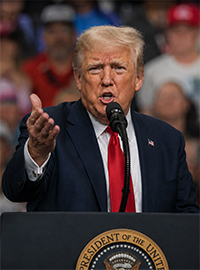
One interesting thing about listening to President Donald Trump's speeches, as opposed to just reading about them later, is that the listener not only gets to hear what Trump said, he also gets to hear Trump commenting in real time on what the speechwriters intended for him to say. That's the beauty of Trump's longtime issue with the teleprompter; he never sticks precisely to the script. "I hate reading these boring speeches, because, to be honest with you ... isn't it nice to have a president that doesn't have to read a teleprompter?" Trump told the crowd at a law-enforcement themed campaign rally in Garden City, New York, last week. "Teleprompters are easy. They're boring." A small but notable example: When Trump's written speech called for him to take credit for building up the military, the words that actually came out of the president's mouth were: "You know, I built the military, and now I used it – a little bit more than I wanted to, frankly, but that's OK, because we cannot let Iran have a nuclear weapon." It was a revealing moment when the war in Iran popped up in a speech devoted mostly to public safety and the economy. The "a little bit more than I wanted to, frankly" aside seemed a reference to Iran in a number of ways. First, it referred to Trump's determination that a second, large-scale attack was necessary after the first U.S. bombing of Iran's nuclear facilities in June 2025 apparently failed to fully do the job. Second, it referred to the fact that the current war has taken several unexpected turns, to say the least. And third, it referred to the length of the war – nearly six months so far, much longer than Trump originally predicted. Now, with the war in stalemate and midterm elections less than three months away, Trump is asking voters for time. Just a while longer, he suggested, and Iran will be like his other successes. "How about Venezuela?" Trump said. "Venezuela was a one-day war, and now we work great with them. We've taken in millions and millions of barrels of oil ... we're doing good in every way." The way Trump framed the story was that the American economy was going gangbusters, doing extremely well earlier this year, when he reluctantly decided the U.S. had to take a "journey" to Iran. "I said to my guys, I said to Howard, Scott, Marco" – a reference to Commerce Secretary Howard Lutnick, Treasury Secretary Scott Bessent and Secretary of State Marco Rubio – "I said, fellas, we have just had the best month ever, anyone's ever had as president," Trump said. The price of gas was low and the future was bright. "I said, I have bad news for you guys, we have to make a little journey to the Middle East because we have to put out a potential disaster, a very big fire, fire like you've never seen." But the war is not settled, and Trump made a big ask for the voters' patience. "So I just say this, for you to pay a tiny little bit more for your gasoline, just remember, you're doing it so that a very evil country cannot have – a country, really, it's the No. 1 state sponsor of terror in the world. We don't want them to have a nuclear weapon. So remember that, when you have to pay a little bit more. You're at $4 [a gallon]. It's OK. I mean, it's – I'm not – I'm not, I'll never apologize. I did the right thing, but you could – you know, if you didn't have [the war] you'd be at, I mean, I had it down to below $2 in many states." It was an extraordinary moment. Talk to any Republican strategist handling midterm races, and he will tell you that GOP voters' biggest concern about the war is the fact that it has resulted in higher gas prices. Those voters support ensuring that Iran does not have a nuclear weapon, but paying a lot more for gas is putting a strain on many of them. So for Trump to minimize the problem in the way that he did – "a tiny little bit more for your gasoline" – seemed tone deaf, at best. It was especially so when he argued that they should be OK with paying more in order to ensure that Iran does not get a nuclear weapon, which is a war goal Trump says the U.S. has already fully accomplished. The big picture on the speech is that it showed Trump struggling with the war at a time when he needs to present a picture of strength and confidence to voters deciding what Congress will look like for the next two years. And that struggle will likely not stop until Trump can figure out a way to extricate himself from the mess in Iran. Byron York is chief political correspondent for The Washington Examiner. COPYRIGHT 2026 BYRON YORK |
Related Articles : |
