























| In Media Probe, Holder Violated DOJ Rules |
 |
|
By Ashton Ellis
Thursday, June 06 2013 |
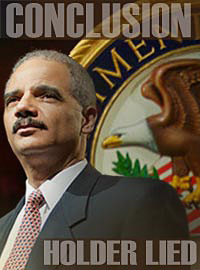
It looks like the First Amendment isn’t the only stricture Eric Holder violated when he targeted Fox News reporter James Rosen for unprecedented secret surveillance. According to official Department of Justice guidelines, the Attorney General failed to apply federally required rules explicitly designed to protect members of the media from government harassment. The guidelines appear in the Code of Federal Regulations, a comprehensive set of rules that carry the force of law. In 28 CFR 50.10, a series of principles are laid out that must be applied by the Attorney General when approving subpoenas against media personnel. Regarding whether to approve a subpoena to demand the records of a reporter like James Rosen, the guidelines warn that, “The subpoena should not be used to obtain peripheral, non-essential, or speculative information.” Moreover, “Even subpoena requests for publicly disclosed information should be treated with care to avoid claims of harassment.” Finally, “Subpoenas should, wherever possible, be directed at material information regarding a limited subject matter, should cover a reasonably limited period of time, and should avoid requiring production of a large volume of unpublished material.” How well did Holder apply these principles to the subpoena of reporter James Rosen? Rosen was targeted because of a story he wrote using a source who leaked classified information about foreign policy. To identify Rosen’s source, DOJ undertook a breathtaking range of surveillance. In derogation of his duty to avoid subpoenas that “obtain peripheral, non-essential, or speculative information,” Holder personally approved of a search warrant that captured Rosen’s phone records and email activity, from both his work and personal accounts. So, despite the command to focus on “information regarding a limited subject matter” for “a reasonably limited period of time,” DOJ investigators gained access to nearly all of Rosen’s communications, the vast majority having nothing to do with contacting a source used in one story. Had Rosen been aware, he certainly would have considered DOJ’s investigation “harassment.” After all, the Constitution is on his side. The First Amendment protects journalists from prosecution for publishing government secrets per the Supreme Court’s 1971 decision in New York Times v. United States (i.e. the “Pentagon Papers” case). According to the holding, the government can prosecute its own employees for leaking, but it cannot go after members of the media that publish the information. That’s why federal prosecutions of leaks don’t target the press. Until, that is, Eric Holder apparently decided to shirk precedent and policy when it became inconvenient. Attached to the Rosen search warrant was a sworn affidavit by FBI agent Reginald Reyes accusing the journalist of being a co-conspirator with Stephen Kim, the State Department employee who allegedly leaked the classified information. Characterizing Rosen that way puts his conduct on the same level of criminal culpability as Kim, who is now being charged with espionage. Within that construct, it is easier to understand why a federal judge granted DOJ’s search warrant: Rosen wasn’t just a reporter doing his job, but a national security threat deserving prosecution. With the details of the probe now public, Holder is singing a different tune. Barely two weeks ago, he told a House committee that “With regard to the potential prosecution of the press for the disclosure of material, that is not something that I’ve ever been involved in, heard of or would think would be a wise policy. In fact, my view is quite the opposite.” But how could it be? Before becoming Attorney General, Holder worked for 12 years in DOJ’s Public Integrity unit, and then five years as a District of Columbia judge. After that, he served as the U.S. Attorney for D.C., then as Deputy Attorney General under Janet Reno. With that resume, it is impossible for Holder to claim that he was unaware of DOJ’s media subpoena guidelines. Equally as absurd is any claim that he somehow misunderstood how the characterization of Rosen as a co-conspirator would look to a federal judge. The scandal here is that all of the available evidence points to an inescapable conclusion: Holder deliberately lied. That he did so either to a federal judge or to members of Congress, both under penalty of perjury, raises a strong presumption that he is unfit to be Attorney General. If an investigation confirms this presumption, the House of Representatives should not hesitate to impeach him. |
Related Articles : |
