




|
|
|








| Three Senators, Three Challenges: Cruz, Paul, Rubio and the Road to the White House |
 |
|
By Troy Senik
Thursday, April 23 2015 |
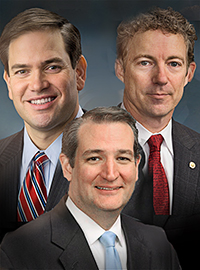
Republicans have no idea how good they have it. Back in 2012, the GOP presidential field looked like it was made up of guys who had responded to a Craigslist ad. While only three candidates — Senators Ted Cruz, Rand Paul and Marco Rubio — have officially announced that they’ll be pursuing the Republican nomination in 2016, each member of that trio could plausibly be argued to have more political talent than the entire 2012 field combined. Of course, there won’t be three for long. At present, there are nearly three-dozen other Republicans considering a White House bid in 2016. And that ups the stakes for Messrs. Cruz, Paul and Rubio considerably. A weak field leaves plenty of slack in the reins. You can get away with a lot of mistakes when voters don’t have any palatable alternative (see: Romney, Mitt). With this embarrassment of riches, however, a candidate could see himself tumble from grace for even the most superficial of sins. That’s salient for this triumvirate of freshman senators, each of whom has one major liability to overcome with Republican primary voters. Let’s take them one by one. Ted Cruz — Learn How to Play Nice With Others There’s no doubt that a big part of Ted Cruz’s appeal owes to his fighting spirit. The Texas Senator has endeared himself to the conservative base largely because he has made clear that he is far more interested in rolling back progressivism than making an accommodation with it. That fervor, however, is just as much a liability as an asset. While Cruz has often portrayed himself as a lonely crusader for principle, a lot of his fellow Republicans see a show horse with more talent for getting media coverage than for actually getting anything done. Yes, the government shutdown was high theater, but it didn’t actually move the nation any closer to Cruz’s stated goal of defunding ObamaCare. That kind of preening may work in the Senate (in fact, it may be the only thing that works in the Senate), but Cruz will likely have to convince Republican voters that he can actually deliver on his promises (and that he's not so polarizing as to be toxic in a general election) before he starts cultivating a critical mass of primary supporters.
If it feels like Rand Paul has been on the political scene longer than the four years he’s been Kentucky’s junior senator, it’s because the movement around him significantly predates his election to office. Paul has inherited the following that his father cultivated with his 2008 and 2012 presidential campaigns…which is a mixed blessing. Ron Paul’s support was deep — you’d be hard-pressed to find any politician with similarly fervent followers — but not especially wide. For many voters, the elder Paul seemed a bit too much of a fringe figure to take seriously. Rand Paul’s entire political career has been a balancing act in which he’s attempted to retain the loyalty of his father’s supporters while appealing to a broader audience. Whereas Ron wants to abolish the Federal Reserve, Rand simply wants to audit it. Whereas Ron once declared in a presidential debate that he’d be fine with legalizing heroin, Rand has instead limited himself to efforts to rein in the excesses of the war on drugs. Whereas Ron is opposed to virtually every exertion of American power overseas, Rand simply advocates for defining America’s international interests more narrowly. That tightrope routine has led a lot of Republicans to question whether Rand is genuinely his own man or is just far more cagey than his father about the extent of his libertarianism. Until that question is answered definitively, many GOP primary voters may be too wary of a bait-and-switch to hand their votes over to Paul. Marco Rubio — It’s A Matter of Trust Let’s be honest. If a Republican political consultant was building a presidential nominee in a lab, he’d look a lot like Marco Rubio: young, handsome, Hispanic, articulate, possessed of a great American rags-to-riches story and hailing from the biggest swing state in the country. There may not be another candidate in this field who starts out with so many inherent advantages. Rubio, however, is dogged by the record that he has amassed during his single term in the Senate. His single biggest liability: his failed push for immigration reform. That effort hurt Rubio on two fronts. First, it made Republicans question his conservative bona fides, as many critics alleged that he was far more interested in securing legal status for illegal immigrants than stepping up border security. Second, it called his political judgment into question, as it eventually became clear that he was getting rolled by Senate Democrats more interested in demagoguing Republican opposition to the plan than in actually getting it passed. This represented a massive miscalculation on Rubio’s part. As the most prominent Hispanic Republican in the country, he had no need to go the extra mile to appeal to the Latino community. Moreover, it raised serious questions about his political maturity, eliciting comparisons to Barack Obama’s too-rapid rise to the White House. If Rubio wants to win back the trust of Republican voters, he’ll have to make a persuasive case that he’s learned from his mistakes rather than defending an unambiguous legislative failure. |
Related Articles : |
