




|
|
|



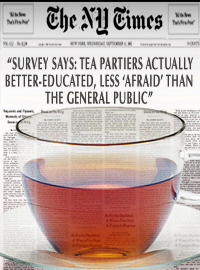
| New York Times Survey: Tea Partiers Actually Better-Educated, Less “Afraid” Than the General Public |
 |
|
By Timothy H. Lee
Thursday, October 21 2010 |
Preening liberals are simultaneously irritating but ironically amusing whenever they expose their own ignorance while attempting to label Tea Partiers “ignorant.” The latest catalyst for liberals’ self-embarrassing epidemic of spitting into the proverbial wind, of course, was this week’s Delaware debate between Republican Senate candidate Christine O’Donnell and her Democrat opponent Chris Coons. At one point during the debate, the two candidates disagreed about local school districts’ proper role in deciding for themselves such curricular matters as how to teach evolution. At that point, Coons smugly asserted that the First Amendment establishes a “separation of church and state,” saying, “the First Amendment establishes a separation.” Unfortunately for Coons and those in the crowd who descended into contemptuous giggles, the phrase “separation of church and state” appears nowhere in the actual text of the Constitution. Rather, that was merely a term used by Thomas Jefferson within a personal correspondence in 1802. Thus, Jefferson’s private words constitute no greater Constitutional authority than contrary statements advancing a Judeo-Christian outlook from such figures as Abraham Lincoln or George Washington. What the First Amendment actually prohibits is the “establishment of religion,” but an enormous difference exists between a formal establishment of religion by the federal government (as illustrated by the Anglican Church of England, with which the Founding Fathers were well familiar) and a strict “separation of church and state.” Accordingly, it was actually Coons who flubbed that particular faceoff, not O’Donnell. Moreover, it makes for quite a spectacle when someone like Coons, the crowd attending the debate or mainstream media pundits attempt to condescend when they’re actually exposing their own intellectual flaws. More broadly, however, what occurred Tuesday evening in Delaware was nothing new. Rather, it was just the latest opportunity for liberals to falsely reassert the ignorance of the Tea Party or candidates it supports. But liberals’ delusion on this issue reveals that they not only fail to read the Constitution, they don’t even carefully read their own New York Times. If they had, they’d have long ago digested some inconvenient facts about the Tea Party they so loathe and perpetually disparage. Namely, a headline in the April 14, 2010 edition of the New York Times unambiguously announced, “Poll Finds Tea Party Backers Wealthier and More Educated.” According to the survey, 23% of Tea Party supporters listed “College Grad” as “The last grade in school you completed,” versus 15% of respondents generally, and 14% of Tea Party supporters have completed post-graduate studies compared to 10% of other respondents. Tea Party supporters were also more likely to have completed “some college” by a 33% to 28% margin, and substantially less likely (only 3%) to have not completed high school than non-supporters (12%), or to possess only a high school degree (35% of non-Tea Party supporters versus 26% of supporters). Notably, the New York Times survey also revealed that Tea Party supporters are substantively wealthier than the general population, more likely to be either employed or retired and substantively less likely to be concerned “that in the next 12 months you or someone else in your household might be out of work or looking for a job.” Here’s why those particular survey findings are important. President Obama, in his constant search for campaign rhetoric that will gain polling traction and avert an electoral disaster, has now resorted to claiming that voters who oppose his agenda are somehow irrational and scared. Speaking at an exclusive Democratic fundraiser last weekend, Obama proclaimed from his high perch, “Part of the reason that our politics seems so tough right now, and facts and science and argument does [sic] not seem to be winning the day all the time, is because we’re hard-wired not to always think clearly when we’re scared.” But as even the New York Times survey acknowledges, Obama’s most potent political opposition is actually better-educated and less “scared” than the rest of the public. Events this week have thus distilled an important lesson: It’s not the Tea Party that is ignorant or frightened, but rather its opponents. |
Related Articles : |
