




|
|
|















| Obama Admin Finally Upholds the Rule of Law |
 |
|
By Ashton Ellis
Tuesday, September 17 2013 |
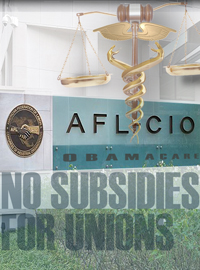
In a win for the rule of law late last Friday, the Obama Treasury department said it will not go against the plain meaning of the Affordable Care Act (ObamaCare) to carve out a costly exception for certain labor unions. The decision was made public in a letter to Senator Orrin Hatch (R-UT). Earlier in the week, Hatch, the highest ranking Republican on the Senate Finance Committee, and Representative Dave Camp (R-MI), Chairman of the House Ways and Means Committee, asked whether the Obama administration was attempting to – once again – rewrite the law on its own. In light of several media reports, Hatch and Camp were concerned that a mounting pressure campaign from labor unions would result in an illegal waiver of ObamaCare’s clear terms in order to benefit an important Democratic constituency. At issue is the post-ObamaCare viability of multiple-employer, or Taft-Hartley, union-run health plans. As I’ve written before, current law allows unions representing an estimated 20 million part-time and seasonal workers to dangle union membership as the only realistic option for securing health insurance. The gatekeeper role allows union leaders to perpetuate their existence. But since union members in those plans already have health insurance, they don’t qualify for ObamaCare subsidies. That’s because the law restricts eligibility to poor and middle-income people currently without health insurance. Unions have been arguing that their members should be eligible for subsidies because health insurance under the union plan – like health insurance for everyone – will be more expensive when all of ObamaCare’s coverage mandates are absorbed. But Hatch and Camp point out that union members, like everyone else covered by an employer, “are not taxed on the contributions their employers pay into the plans on their behalf. The contributions are excluded from the worker’s income for tax purposes.” Thus, to extend subsidies to unions while retaining the income tax exclusion would be a textbook case of “double dipping.” There’s more. Even if union members were given ObamaCare subsidies, union health plans could not accept them unless the plan is designated as a qualified exchange plan. If granted, this rule change would mean that union-run health plans would have the same legal status as any other health insurance company operating on an exchange. Except, of course, that a union plan would still be able to deny admission to non-members, something no other insurance company is allowed to do under ObamaCare’s “guaranteed issue” rules. Amazingly, the Obama administration was actually considering whether to allow union members to double dip so that union leaders could maintain their hold on power. That came to a halt when the Treasury department replied to Hatch with a tightly worded letter saying, “Treasury believes, as suggested in your letter, that an individual who is covered by an eligible employer-sponsored plan would not be able to receive a premium tax credit [i.e. an ObamaCare subsidy].” In reasoning that parallels Hatch and Camp’s letter, the Treasury department said there is no distinction in ObamaCare’s text between an employee covered by a single-employer plan and one covered under a multiple-employer version. As such, so long as an employee in either plan is covered, no subsidies can be given. As is typical of the Obama administration, Treasury’s response was delivered late on a Friday afternoon at the end of the week’s news cycle. Still, the announcement is a breath of fresh air. In light of other unilateral waivers that delayed such seemingly important elements as the employer mandate and verifying a person’s income-eligibility status, the idea that well-connected unions might get a windfall was plausible. That they didn’t is a reason to cheer – even if, so far, it’s the exception that proves the rule. |
Related Articles : |
