




|
|
|











| Republican Governors Opt for ObamaCare Medicaid Expansion at Taxpayers’ Expense |
 |
|
By Ashton Ellis
Wednesday, February 06 2013 |
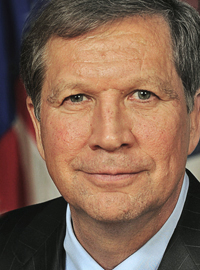
With another Republican governor reversing course and agreeing to expand Medicaid spending under ObamaCare, it’s becoming increasingly clear that the real reason for the capitulations isn’t a bad understanding of economics – it’s first-rate political opportunism. On Monday, Ohio Republican Governor John Kasich announced he would accept the terms in the Patient Protection and Affordable Care Act (ObamaCare) to expand the eligibility rolls for Medicaid. Those terms include replacing existing state-determined eligibility formulas with universal Medicaid coverage for anyone below 138 percent of the federal poverty line. Nationwide, the growth in Medicaid eligibility is estimated to capture 15 to 18 million more people than the program currently covers. How to pay for all this new spending is where the states come in. Before ObamaCare, Medicaid was already one of the fastest growing budget items in every state budget. That’s because for every $1 of state spending on Medicaid, the federal government chips in $2. To get otherwise fiscally responsible governors to go along with a massive entitlement expansion, ObamaCare’s authors included a poison pill that waits at least three years to wreak havoc on state budgets. Starting in 2014, the federal government will fully fund every dollar of expansion a state wishes to pursue. In 2017, the funding starts to drop before leveling off at 90 percent in 2020. Thereafter, assuming no changes in ObamaCare’s Medicaid funding formula, the states must cover 10 percent of their Medicaid usage. Along with Ohio’s Kasich, ObamaCare’s Medicaid deal appeals to four other Republican governors: New Mexico’s Susana Martinez, Nevada’s Brian Sandoval, Arizona’s Jan Brewer and North Dakota’s Jack Dalrymple. The question is why? On its face, the ObamaCare Medicaid expansion seeks to dramatically increase the number of people using Medicaid as their primary health care insurer. In financial terms, this means that, on its face, ObamaCare seeks to dramatically increase the amount of spending on Medicaid by both the federal and state governments, which in reality means spending by taxpayers. Even at only 10 percent of the cost, states will have to increase their spending on Medicaid-related services to meet their obligations. An analysis by the Heritage Foundation pegs the costs to states between $41 billion to $120 billion between 2017 and 2022. The reason for the large spread is that no one actually knows how closely the Obama Administration will follow the terms of ObamaCare’s payment schedules. By its terms, ObamaCare says that it will gradually reduce funding from 100 percent to 90 percent between 2017 and 2020. But President Barack Obama’s own budget proposal for fiscal year 2013 gives reason to doubt. In it, the President calls for a “blended rate” compensation formula. This would average the federal share of Medicaid spending with other matched spending like the Children’s Health Insurance Program. This move is designed to reduce federal spending by offloading the remaining costs onto state budgets. Thus, while the terms of ObamaCare indicate that the states collectively would pay around $41 billion for their 10 percent share of Medicaid between 2017 and 2022, the blended rate as proposed by the President’s most recent budget could surge that number to $120 billion for the same time period. To be fair, the White House has since backed away from the blended rate proposal. But let’s be serious. Some form of the blended rate is undoubtedly coming. With $1 trillion budget deficits for each of the last four years, federal officials are looking for ways to improve the nation’s balance sheet, even if it means destroying those at the state level. But hand it to the GOP capitulators – they know how to read a political calendar. Of the five, only North Dakota’s Dalrymple has the ability to serve as governor from now until the true cost of a state’s Medicaid expansion comes due in 2019. The others are saved by different term limits requirements that will allow them to spread the blame around. In the meantime, they can look forward to enjoying nearly an entire second term getting accolades for expanding Medicaid eligibility without having to pay (or rather, tax) for it. Though some bills will come due in 2017 and 2018, the real sticker shock won’t hit until the first year of someone else’s first term. Thus, plugging the Medicaid-shaped budget hole will be someone else’s problem. Not exactly a profile in courage. |
Related Articles : |
