By Troy Senik
Thursday, July 15 2010 |

|
With unfunded pension liabilities of approximately $500 billion...the nation’s most populous state has backed itself into a corner from which it cannot escape.
|
|
| In this age of fiscal sophistry, the language of public finance is riddled with economic alchemy. The federal government moves $877 billion from Washington’s coffers to those of its most favored interest groups and calls it “stimulus.” The Speaker of the House declares that unemployment benefits serve as “one of the biggest stimuleses [sic] to our economy” – a perverse formulation by which growth is contingent on impoverished Americans spending what little money they have as quickly as possible. Even President Obama’s fiscally reckless health care entitlement is sold as an “investment” that will produce “long-term savings.”
But what each of these polices lack in economic sensibility they make up for in reversibility. The stimulus is mercifully self-extinguishing. Unemployment benefits can be restructured or, more hopefully, reduced through an improving labor market. Even ObamaCare may yet be reformed or even repealed.
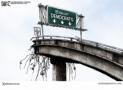
No such luxury presents itself in the case of the nation’s public pensions, which are perilously close to creating a fiscal doomsday unlike anything the nation has ever seen. And here the rhetorical dishonesty is even more pronounced. What has been sold as a promise of financial security threatens to tear apart the infrastructure of public finance in our most profligate states. The beneficiaries are thus being promised a golden throne in a demolished castle.
On the topic of things that are not as golden as they seem, California is, as always, the cautionary example du jour. With unfunded pension liabilities of approximately $500 billion (which is to say more than 25 times the amount of the deficit currently bringing the state to a political and economic standstill), the nation’s most populous state has backed itself into a corner from which it cannot escape.
Though liberals (who are usually more concerned with extinguishing the sentiment behind pension reform than acknowledging the facts behind it) like to point to the current recession as the culprit in creating this yawning financial gap, that explanation leaves something to be desired. True, California’s two largest pension funds did lose nearly $100 billion between them in 2009. But that doesn’t obviate the state government’s responsibility for increasing pensions for public safety workers by 20-50 percent in the last decade. And with a business climate recently ranked worst in the nation by over 600 CEOs, the Golden State has little prospect of growing itself out of the hole.
Despite the best efforts of those who’d like to quarantine the madness, however, California looks to be a leading indicator. As Northwestern University professor Joshua Rauh has noted, “half the states’ pension funds could run out of money by 2025.” And with a federal government staring at $14 trillion in debt, the states shouldn’t expect relief from Washington anytime soon.
None of these numbers have been kept secret in the recent past. Economists have been warning of an entitlement tsunami for decades. But perhaps where cold, hard reason has failed, theater can suffice. One need only look to the bonfire of the public sector vanities sweeping Greece to know where this road ends. Whether the states summon the courage to act in time will be dispositive. There are no second chances to be a first-rate nation.
|