




|
|
|


| Obama Is Taking an Economic Flu Patient and Giving It Pneumonia |
 |
|
By CFIF Staff
Thursday, May 28 2009 |
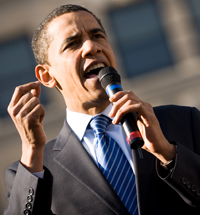
Although that was certainly down from its October 2007 record peak, the market already reflected the preceding months’ housing and financial sector shocks. It’s also worth noting that at that point, the magnitude of the correction was similar to the tech bubble correction earlier this decade, from which the Dow recovered in its usual manner... On November 4, 2008, the day Barack Obama was elected President, the Dow Jones Industrial Average stood at 9,625. Although that was certainly down from its October 2007 record peak, the market already reflected the preceding months’ housing and financial sector shocks. It’s also worth noting that at that point, the magnitude of the correction was similar to the tech bubble correction earlier this decade, from which the Dow recovered in its usual manner. Between Election Day and Inauguration Day, the economy subsequently had over two months to assess the prospects of the Obama agenda and the signals that he was sending. Each new cabinet appointment, each new speech and each new policy proposal was digested to determine whether Obama would fulfill his solemn campaign promise to govern as a bipartisan moderate or assume the role of big-government extremist. The verdict during that period? Decidedly negative, as the Dow plunged an additional 1,344 points to 8,281. Then, on January 20, 2008, the day on which Obama became President, the Dow suffered its worst Inauguration Day in history, declining fully 4% to 7,949. By the end of the month, stocks completed their worst January in history, falling 9% to just above 8,000. And now, in the month just completed, the Dow suffered its worst February in over 75 years. Thus, in the six short weeks since Obama won the White House, we have already witnessed the worst Inauguration Day in history, the worst January in history, the worst February since 1933 and an astounding 30% evaporation of total market wealth. Those ugly realities aren’t mere coincidence, and they naturally raise the question that increasingly dominates current political discourse: is Obama simply making a difficult economic situation worse? Is he taking an economic flu patient and giving it pneumonia? To answer that question, the central concept to keep in mind is that stock markets are, by their very nature, forward-looking, not retrospective. They generally don’t dwell on past circumstances or linger in reflection of past news events. Rather, markets reflect a real-time prospective assessment of where the economy is headed. Accordingly, the Dow is more concerned with what lies in the future under a President Obama than with what occurred during President Bush’s tenure. A second critical point to consider when answering that question is that markets are early economic harbingers, as opposed to trailing indicators such as employment figures. In other words, of the plethora of economic data available, markets are among the most expeditious. Accordingly, while stock markets are not perfect, they tend to be the most immediate barometers of current and future economic realities. Obviously, no one person or event singularly accounts for market direction, and past circumstances shaped current conditions and future expectations. But with those realities in mind, the simple fact is that the economic recession that began in December 2007, the financial shocks and the housing bubble have been baked into the market cake for some time now. President Bush cannot be scapegoated forever, and “tax cuts” cannot be blamed for economic difficulties when incoming federal revenues actually reached all-time highs during his tenure. Rather, it is increasingly clear that Obama himself is inflicting new wounds upon the national and global economies. After all, since his election in November, the economy has encountered few significant unexpected new shocks or fundamental revelations. Rather, what we have witnessed is a Barack Obama who has renounced his campaign promises to govern as a moderate, and instead commenced the most radical upheaval of the relationship between government and the economy in history. During his campaign, for instance, Obama promised to reduce the federal budget deficit, but his spending proposals will literally double the entire national debt in five years, and triple it five years later. During his campaign, Obama promised to eliminate earmarks and scour the budget “line-by-line,” but the sudden reality is that the new omnibus spending ` contains almost 9,000 earmarks and billions in wasteful spending. In addition, Obama has proposed to tax carbon emissions for the first time in our history to the tune of $600 billion, as if any business or industry in the present economic climate sits idly on that large a reservoir of cash. He has also proposed untold trillions of dollars in tax increases and new spending proposals under the guise of “stimulus,” centralized healthcare spending, housing programs and repetitious bailouts of sclerotic industries whose decades of poor decision making put them in their current morasses. And now, the economy is showing the consequences. This isn’t partisanship or ideology – it’s economic fact. Fortunately, even Democrats are beginning to recognize these facts. The question now becomes whether we will stop Obama’s misguided agenda before the market and economy get even worse. |
Related Articles : |
