|
What really matters is the size of government: how much of the nation’s private economy is being commandeered by the state.
|
|
| The two biggest stories out of Washington last week made for a bizarre bit of political synchronicity.
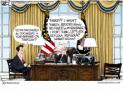
On Thursday morning, President Obama announced the creation of a new bipartisan commission aimed at reigning in the national debt – a move largely seen as a reaction to growing agitation on the issue from fiscally conservative Republicans and Independents. A few hours later, on the other side of the District of Columbia, former Vice President Dick Cheney – a man who memorably said that “deficits don’t matter” – received a standing ovation during a surprise appearance before precisely that demographic at the Conservative Political Action Conference. What explains this seeming contradiction?
The knee-jerk reaction on the left was to paint Republicans as fiscal hypocrites happy to spout limited-government pieties when their absence from power precludes their violation of principle. If you accept the wisdom that past behavior is the best predictor of future behavior, this notion can’t be dismissed out of hand. But a deeper principle is at work.
In a limited sense (perhaps far more limited than Cheney intended at the time he said it), the former Vice President was correct to note that deficits are not, in and of themselves, deeply significant. All a deficit actually tells you is how much of a nation’s fiscal obligations are being financed through future claims on taxpayer earnings (read: debt) as opposed to current revenues. Insofar as deficits increase the costs of governing (via the payment of interest), encourage reckless spending and crowd out the market for private lending, they are destructive. But in and of themselves they are hardly the end of the world (except for a brief period under Andrew Jackson, the United States has almost always been in debt).
What really matters is the size of government: how much of the nation’s private economy is being commandeered by the state. As former House Majority Leader (and Ph.D. in economics) Dick Armey demonstrated with his “Armey Curve,” beyond a certain size government goes from being a support to the economy – through the provision of basic public goods like infrastructure, law enforcement and public safety – to a drain on it. This makes intuitive sense. Every dollar spent in the public sector has to first be removed from the private sector. In the private sector, it’s only spent when a consumer finds the value of a good or service to be greater than the value of the money in his wallet. In the public sector, it’s usually spent for political reasons. That’s a formula tailor-made for decreasing the value of an economy.
Consider this thought exercise: Last year, the federal budget ate up almost 25 percent of America’s GDP (In other words, one out of every four dollars went to federal spending – the highest peacetime percentage in American history). But much of the cost of that spending was deferred because it was financed via deficits. If your goal is nothing more than a balanced budget, you can theoretically do so by hiking taxes until the full 25 percent of GDP can be paid out of current accounts. But would that balanced budget be preferable to an economy where spending was only 15 percent of GDP, but was partially financed via deficits? Absolutely not. When it comes to budgets, the key factor for economic growth is minimizing the amount of money annexed by government.
This is what makes the Obama agenda so dangerous. Balanced budgets won’t make a difference if the balance is achieved by pairing excessive spending with excessive taxation. But if the country spends a trillion dollars to overhaul health care, punishes the industrial sector with cap and trade and continues to promise entitlements like a spendthrift tooth fairy, there’s no other option. And with higher taxes cutting off the private sector’s productive capacities, the revenue base to finance these grandiose promises will only shrink further – creating an inevitable fiscal death spiral.
A Democratic president who was willing to tackle this issue head on would earn the “transformative” label that Obama pursues with the obsession of Captain Ahab for Moby Dick. But at the moment, that president doesn’t exist. |