



|
|
|

















| Studies Show Connection Between Free Markets and a Cleaner Environment |
 |
|
By Ashton Ellis
Wednesday, February 16 2011 |
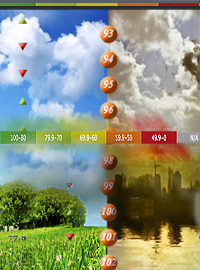
Nice things cost money. In the 2011 edition of its Index of Economic Freedom, the Heritage Foundation demonstrates that national wealth – not stringent regulations – is the key to creating a cleaner environment. The Index of Economic Freedom is a joint project of the Heritage Foundation and the Wall Street Journal that ranks 183 economies on 10 factors of economic freedom. The measures evaluate an economy’s openness, rule of law and competitiveness. Heritage expert Ben Lieberman explains the correlation between prosperity and environmental protection: “One can think of environmental protection as a good that only prosperous societies can afford. People who lack the necessities do not have the luxury of worrying about endangered species or the health of forests, and even if they did, they would not have the wherewithal to do much about it. However, as economies develop, a point is reached at which there is both the willingness and the means to address environmental concerns. Most countries show increasing levels of environmental harm over time until a certain level of per capita wealth is achieved, and then the environment begins to improve.” The point at which environmental protection becomes affordable for a growing economy is illustrated by the Environmental Kuznets Curve. At first, as per-capita income increases the environment decays. One cause is the environmental cost of industrialization where manufacturing gains are often tied to increased pollution. However, when the turning point of personal income is reached, a wealthier society can now afford to demand (and pay for) cleaner production methods that improve the environment. The insight is applicable in other contexts. When a person is poor and desperately hungry, he will consider just about anything edible. With each step up the socio-economic ladder, one’s culinary standards increase, as do the costs associated with eating better prepared, cleaner food. Certainly, there is a place for government regulations guaranteeing the purity of food just as there is for policing blatant harm to the environment. Contaminated drinking water and adulterated food are in no one’s interest. Yet, the evidence from the Index of Economic Freedom suggests that policymakers should be careful not to put the regulatory cart before the economic workhorse. Indeed, the primacy of economic freedom on a society’s overall well-being was highlighted in a 1999 comparison between Heritage’s Index and the Freedom House scores for political and civil liberties. According to Heritage’s Kim R. Holmes, the side-by-side analysis revealed two striking correlations: 1. “Countries that are more economically free also tend to be more politically free; and 2. “There is an even stronger link between economic freedom and civil rights such as freedom of assembly, an independent media and equality of opportunity. That relationship was statistically significant at 99 percent.” In other words, freedom cannot be confined to a discrete area of human action. Whenever governing elites try to manage their citizenry’s access to freedom along a predetermined measure of success, the economy stagnates. As Heritage’s Lieberman notes, the autocratic regimes in North Korea and Zimbabwe preside over two of the world’s worst economies, and have terrible environmental records. If promoting human rights and protecting the environment are the goals of so many on the Left, a growing economy must be their means. In a way, the Index of Economic Freedom is another reminder of what ought to be any government’s primary objective: enacting pro-growth policies that enable societies to pay for a better quality of life. As elected officials across America race to cut spending on popular but expensive programs, the lesson to be (re)learned is that only wealthy societies can afford to spend resources maintaining living standards above subsistence. After all, nice things cost money. |
Related Articles : |
