




|
|
|






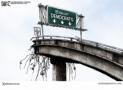
| Fiscal Gap Worse Than Fiscal Cliff |
 |
|
By Ashton Ellis
Thursday, December 13 2012 |
Negotiations to avoid the fiscal cliff are understandably focusing on whether to cut or raise taxes and spending. But those issues are secondary. The real problem facing the federal budget is the unsustainable cost of entitlement programs like Social Security, Medicare and Medicaid. If structural reforms aren’t made soon, the burden on future taxpayers will overwhelm any tax-and-spending deal reached now. In a recent report, the General Accounting Office (GAO) analyzed two scenarios that show how little difference the current focus on tax rates and spending levels will make to the long-term deficit. The first scenario is called a Baseline Extended simulation. It assumes that no changes will be made to current law, meaning that no deal is reached and we go over the fiscal cliff. Thus, the Budget Control Act (BCA) of 2011 goes into effect in January, eliminating the Bush tax cuts for all income groups, hitting thousands of tax filers with the Alternative Minimum Tax and cutting 10 percent from every federal department’s budget. The GAO’s Alternative simulation assumes that the BCA does not become law because President Barack Obama and Congressional Republicans are able to strike some kind of deal. For simplicity’s sake, GAO assumes that all of the Bush tax cuts are extended and the AMT is indexed for inflation, thus sparing taxpayers otherwise newly snared. GAO also assumes discretionary spending is cut, but not as drastically. Under either scenario, the long-term fiscal outlook is grim. According to GAO, going over the fiscal cliff and letting the BCA become operational means “debt as a share of GDP declines in the short term before turning up again. In the Alternative simulation, in which these laws are assumed to not take full effect, federal debt as a share of GDP grows throughout the period.” In other words, the BCA makes a slight improvement in the deficit before piling up more debt. But even that saving comes at a price. If consumers are suddenly hit with higher income taxes they will have less money to spend in the marketplace, hurting economic growth. Across-the-board spending cuts will impact participants in industries as diverse as higher education and defense contracting, not to mention state programs dependent on federal funds. But at least the BCA saves some money. As the GAO’s Alternative simulation makes clear, simply taxing and spending at today’s rates is even worse. America is already hurtling toward yet another debt ceiling debate because spending is drastically outpacing tax revenues. If left unreformed, the growing imbalance between tax receipts and payouts will result in more than 50 percent of the 2040 budget being eaten up by non-discretionary spending and interest payments on the national debt. This brings us to the real insight in the GAO study. The problem causing the federal budget deficit isn’t primarily the level of taxes or spending, though they are major concerns. Rather, it is the cost of non-discretionary entitlement programs like Social Security, Medicare and Medicaid. As the American population ages, more people become eligible for guaranteed benefits that by law must be paid. That triggers spending, regardless of whether the amount of tax revenues brought in can cover the amount owed. For a glance at the cost, consider Baby Boomers. As the nation’s largest generational cohort, Boomers are retiring at a rate of 7,600 per day, as of 2011. By 2029, that number will jump to 11,000 per day. With more Boomers collecting Social Security and Medicare benefits every day, the percentage of the budget dedicated to those programs grows. The consequences are predictable. In the words of the GAO study, “There is little room for ‘all other spending,’ which includes not only national defense, homeland security, veteran’s health care, and investment in highways and mass transit, but also smaller entitlement programs such as farm price supports and student loans.” In other words, unless significant reforms are made to the big entitlement programs, changes to tax rates and discretionary spending ultimately won’t make a dent in the long-term deficit. No wonder GAO says “simulations continue to illustrate that the federal government is on an unsustainable fiscal path.” The real challenge facing President Obama and Congressional Republicans isn’t avoiding next month’s fiscal cliff. It’s bridging the widening fiscal gap between promises to aging beneficiaries and the inability to pay for them. |
Related Articles : |
