




|
|
|



| Why It’s a Mistake to Underestimate Scott Walker |
 |
|
By Troy Senik
Thursday, November 20 2014 |
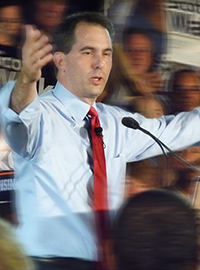
We knew this was coming. With the midterm elections behind us, it’s now open season for 2016 presidential contenders. With Hillary Clinton looking set for a coronation by Democrats (don’t fool yourself, it will get tougher for the former First Lady — but she’s still the favorite to take the nomination) most of the attention is being directed towards the Republican field. Unsurprisingly, the lion’s share of early coverage has been lavished on candidates who already have strong national identities: Rand Paul, Chris Christie, Ted Cruz, Jeb Bush and the like. Don’t be surprised, however, if the mild-mannered but ferociously accomplished governor of Wisconsin soon becomes part of the conversation. Scott Walker is, by any reasonable reading, a political unicorn. In the course of four years, he has now won election as governor of a solidly blue state three times — twice in conventional gubernatorial contests and once in the face of a recall. Moreover, Walker’s track record of success is not based on a model of triangulating to reach moderate or liberal constituencies. Instead, the single biggest accomplishment of his tenure has been unspooling the power of public-sector unions (the impetus for the recall campaign). That victory made him public enemy number one amongst liberals nationwide — and he survived the onslaught in both the recall and this year’s reelection campaign (which, despite predictions that the race would be close, he won by more than five points). Can Walker’s Badger State victories translate into a successful national campaign? There are hurdles to be sure. Walker doesn’t yet have a Q rating comparable to the aforementioned political celebrities. He’s remained relatively quiet on national issues. He does not possess movie star looks, a surplus of charisma, or a dynamic speaking style. Nor does he have any experience in foreign policy, the coin of the presidential realm (though not necessarily of presidential elections). That said, there’s an awful lot of upside. Figures like Cruz, Paul and Rick Perry may warm the cockles of tea partier hearts, but they spook members of the GOP establishment. Meanwhile, the likes of Bush or Christie, perfectly acceptable to the coastal moneymen, inspire mistrust from conservative activists. Walker, however, is one candidate with the potential to bridge the divide. Tea partiers appreciate his hard-won victories over the institutional left and his unwillingness to shrink from a fight. Establishment types respect his cool, collected tone and his proven track record of successful governance. Walker also has the potential to assemble an electoral coalition that builds on the dynamics that have recently driven Republicans to success. As RealClearPolitics’ Sean Trende has noted, one of the crucial factors that hampered Mitt Romney’s 2012 presidential campaign was his lack of appeal to downscale white voters. While this is a group that can be responsive to economic populism of the sort advocated more often by the left than the right, it’s also a cohort that has been singularly excluded from care and feeding by the Obama Administration. As a result of this dynamic, Democrats are hemorrhaging in the middle of the country. Consider the following: in the Midwest (defined here as the Dakotas, Nebraska, Kansas, Missouri, Iowa, Minnesota, Wisconsin, Illinois, Indiana, Michigan and Ohio), 10 of the 12 governor’s seats now belong to Republicans. A majority of the Senate seats — 14 out of 24 — do as well. A Republican candidate with an appeal in that region — and Walker, a blue-collar Wisconsin preacher’s kid who didn’t finish college, may fit the bill — could upend the electoral map. It’s easy to see his candidacy potentially putting four states that Romney lost — Iowa, Ohio, Wisconsin and Pennsylvania (which has similarities with much of the Midwest) — into play. That’s an additional 54 electoral votes. Give Walker a Hispanic running mate — say, Florida Senator Marco Rubio or New Mexico Governor Susana Martinez — and you also likely up his chances of victory in Florida, Colorado, New Mexico and Nevada, swing states that combine for another 49 electoral votes. Combine those two tallies and you’re talking about 103 electoral votes in play. Mitt Romney — who won none of those eight states — fell only 64 electoral votes shy of the presidency. Of course, trying to game out an electoral map at this early stage is a largely academic exercise. There is simply too much time in which too many variables can change. Perhaps, then, it’s best to turn to fundamentals. As I’ve noted in this space before, one defining characteristic of voters electing a new president tends to be a search for someone who provides correctives to the incumbent. Barack Obama is the ultimate triumph of style over substance, with perfectly creased trousers and slick speeches but little in the way of results or managerial competence. Walker will probably never get a GQ cover or give a speech from between faux-greek columns, but he has a record of getting the job done, enacting sweeping change and making government better serve its citizens. Obama reeks of lifelong elitism, from the Ivy League education to the casual references to the price of arugula at Whole Foods. Walker, who left Marquette to take a job with the Red Cross, has the mien of a guy who’d be fine with a burger at the local coffee shop. I’ve long argued that the best analogy for Barack Obama’s tenure in the White House is Woodrow Wilson, a man who shared Obama's academic background, his towering arrogance and his distaste for the Constitution’s separation of powers. In the 1920 election, after eight years of Wilson’s whiplash-inducing progressivism, the White House went to Republican Warren Harding, who ran on the slogan “a return to normalcy.” In most years, that would be an underwhelming rallying cry. When the country is shell-shocked, however, it’s a warm blanket. Scott Walker happens to be a pretty normal guy. And that may just be what makes him exceptional. |
Related Articles : |
