




|
|
|





| The Obama Record: U.S. Stagnates in Annual Index of Global Economic Freedom |
 |
|
By Timothy H. Lee
Thursday, January 29 2015 |
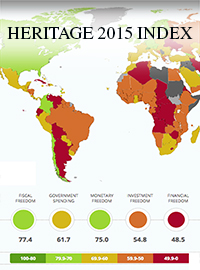
As an amber sun descends on the Obama Administration and its shadow grows long, his emerging legacy becomes increasingly clear. A recent Rasmussen survey broadly captures the negative character of that legacy. When asked at the dawn of the Obama tenure in January 2009, the American public was closely divided on the question of "whether the United States will still be the world's most powerful nation at the end of the current century." Keep in mind that survey occurred during the depth of the recession and layoff tsunami, while Obama self-confidently promised a fresh start and bold recovery through his policies. This month, Rasmussen polled the same question, and the results offer a rude rejoinder to anyone attempting to label the Obama Administration a success. Six long years after his inauguration, the number of people who consider America a nation in decline has increased, not decreased: "Just 27% of likely U.S. voters believe the United States will still be the most powerful nation in the world by the end of the 21st century, down from 37% in January 2009, shortly after the Wall Street meltdown and just before President Obama took office. A new Rasmussen Reports national telephone survey finds that 48% disagree and believe the United States will not be the number one world power, a 14-point increase from 34% six years ago." A similarly damning assessment of the Obama legacy comes by way of the latest annual global Index of Economic Freedom. In partnership with The Wall Street Journal, the Heritage Foundation each year ranks the world's nations on a 0 to 100 scale measuring ten pivotal factors: (1) property rights, (2) freedom from corruption, (3) fiscal freedom, (4) government spending, (5) business freedom, (6) labor freedom, (7) monetary freedom, (8) trade freedom, (9) investment freedom and (10) financial freedom. Based upon those ten factors, the Index in turn places each nation within one of five broader categories: (1) "free," (2) "mostly free," (3) "moderately free," (4) "mostly unfree" and (5) "repressed." Last year, for the first time in history, the U.S. fell from the world's top ten most economically free nations in the world. That followed seven years of steep decline, particularly (but unsurprisingly) during the years 2009 and 2010. This year, the U.S. remained outside of the top ten, maintaining its position at number 12. We also no longer qualify as a "free" nation, but rather as one labeled "mostly free." Adding insult to that injury, overall global economic freedom actually increased for the third consecutive year. In fact, it now stands at a record level. In contrast, the Obama years have taken us to unprecedented lows. Additionally, the U.S. finds itself looking upward at supposedly "socialist" nations sometimes offered by liberals as superior models to America's free-market tradition. That list includes New Zealand in third place, Australia in fourth, Switzerland in fifth, Canada in sixth, Estonia at eighth, Ireland in ninth and Denmark at tenth place. Even the United Kingdom, with its bureaucratic healthcare system, is now only one place behind the U.S. at 13th. The reason the Wall Street Journal/Heritage Index is important, as set forth in statistical detail by the report, is that greater economic freedom results in greater prosperity, less poverty, more democratic progress and higher environmental quality: "The findings of the 2015 Index once again demonstrate the strongly positive linkages between economic freedom and various dimensions of human development. Many of the linkages are straightforward: Higher taxes, for example, reduce investment and hurt job growth. Others, such as the impact on economic growth from the promotion of property rights or the maintenance of a stable monetary system, are more intricate, multidimensional, and nonlinear. Even in these cases, however, the evidence is strong that adherence to the principles of economic freedom is an unmatched strategy for promoting solutions to human problems and advancing overall wellbeing. No alternative systems - and many have been tried - come close to the record of free-market capitalism in promoting growth and improving the human condition." That relationship justifies great concern about America's depressing decline during the Obama years. Fortunately, as Heritage spokesman Terry Miller explains, the corrective 2010 and 2014 elections at least stanched the bleeding: "The 2010 elections, which returned control of the House of Representatives to Republicans, brought some restraint in government excess, a fact reflected in the U.S. economic freedom trend and the recent uptick in U.S. economic activity. The 2014 election promises even greater restraint in the growth of government spending and regulation. Conservatives and libertarians should be happy that divided government in Washington has slowed the growth of government spending." Regardless of which party controls Congress, however, much work remains if we are to reverse the recent years of decline and reclaim our position in the world's top ten. While Obama has largely been rendered impotent, prompt and effective action is needed lest our decline become permanent. |
Related Articles : |
