




|
|
|




| It’s Hard to Vindicate Carly Fiorina |
 |
|
By Ben Boychuk
Thursday, August 27 2015 |
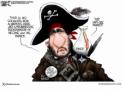
Carly Fiorina has emerged as something close to a top-tier Republican presidential candidate after her stellar showing at the second-tier Fox News debate earlier this month. She’s seemingly been everywhere, talking with just about everyone about the pressing issues of the 2016 campaign — national security, entitlement reform, galvanizing the economy. And given her business background, she appears to be a sane alternative to that other fellow who currently leads in the polls. But with newfound prominence comes scrutiny, and with scrutiny come uncomfortable questions and claims. Fiorina’s appeal rests almost exclusively on her deft handling of the press — did you see the way she jiu-jitsued Katie Couric the other day? — and her background as chief executive of Hewlett-Packard from 1999 until her severance in 2005. Therein lies her problem. Put charitably, Fiorina’s tenure at HP was controversial. The printer-manufacturer was foundering when she was hired. Her main accomplishment was the 2002 merger of HP with Compaq, a PC maker that was in even deeper financial trouble than Hewlett Packard. Expanding HP into the PC business did help boost the company’s revenues, but not its profits. Share prices tumbled and HP’s board let her go. Fiorina contends she was ousted by a dysfunctional (and crooked) board that didn’t like her aggressive style in turning around a sclerotic company. And, in fairness, she is not alone in telling that story. A pro-Fiorina super PAC bought a full-page ad in Thursday’s New York Times that features a testimonial from Tom Perkins, venture capitalist and founder of Kleiner Perkins Caufield & Byers and a member of HP’s board of directors when Fiorina was CEO. Perkins attempts to rebut claims published in the Times and elsewhere that Fiorina was an inept, divisive and ultimately ineffective leader. On the contrary, Perkins argues, she was “the right choice” to revive a stagnating company struggling in a brutal, post-dot com bubble economy. He lauds her as a “a change agent” and a “transformational leader.” “Critics often claim [Fiorina] was fired at HP because she was unsuccessful,” Perkins writes. “As a member of the board, I can tell you this is not true. In truth, it was the board I was a part of that was ineffective and dysfunctional.” He describes how some board members tried to micromanage the company around Fiorina, choosing friends and family members for top posts. “Carly worked with the hand she was dealt as best as one could,” Perkins argues. Then he points to her record. “HP revenues doubled to more than $80 billion, innovation tripled to 15 patents per day, the growth rate more than quadrupled 6.5 percent and we grew to become the 11th largest company in the country,” Perkins writes. As for the controversial merger with Compaq, Perkins insists “history proves Carly was right.” “Post merger, HP became the biggest computer company in the world,” he writes. “It positioned HP to compete in integrated systems and allowed us to compete in sectors beyond the core strength of the company, printers.” Bold claims. Are they true? When we consider presidential legacies, we look at how policies and decisions that looked risky, even foolhardy, at the time worked out over the long term. Ronald Reagan’s decision to fire more than 11,000 striking air traffic controllers in 1981 was one of the first big tests of his administration. The media crucified him, but, to paraphrase Perkins, history proved Reagan right and showed how arrogant government-employee unions could be brought to heel in places like Wisconsin, Michigan, Indiana and New Jersey, where Republican governors have eliminated or severely restricted collective bargaining. Fiorina predicted HP’s merger with Compaq would leave the company stronger in the long run. She claims her prediction was born out. “When you manage in tough times, when you lead in tough times, sometimes tough calls are necessary,” Fiorina told the Des Moines Register, “and yet we took that company from about $44 billion to almost $90 billion.” (Note the discrepancy between Fiorina’s figure and Perkins’.) But as numerous business analysts have pointed out over the years, the PC business actually dragged down HP’s profitability and resulted in some 30,000 layoffs. “In 1999 when she arrived at the company, HP had $42 billion in sales and $3.1 billion in net earnings. When she left in 2005, HP had $87 billion in sales but only $2.4 billion in earnings,” write Andy Serwer with Tae Kim at Yahoo! Finance. “In subsequent years HP would become more profitable—to a large degree due to cost cutting by her successor as CEO, Mark Hurd—but the company would never become the moneymaking juggernaut Fiorina promised.” Part of the blame for that may well fall on the dysfunctional board, but surely not all. Drawing an analogy between running a Fortune 500 company and governing a nation of some 320 million people is perilous. The oft-heard refrain that America is like a big company and we need a CEO to run it is simply wrong. The United States is — or was — a free republic of self-governing people. Americans are citizens, not clients or customers. The federal government is supposed to be in the business of securing individual rights, not providing more efficient services or better customer service. Fiorina is not the same candidate she was five years ago, when she lost her U.S. Senate race in California to Barbara Boxer. She’s more surefooted now. She takes no guff from know-it-all cable news bloviators. She stays mercilessly on message. She’s difficult not to like. But rhetoric goes just so far. Perhaps Fiorina would prove a better president or vice president than CEO. But if Fiorina is running on her record as a corporate leader, her growing cadre of supporters and fans need to take account of the whole record. |
Related Articles : |
