|
Men like Norman Borlaug are rare. How does one define his legacy? To be honest, I don’t know. But I’d say there are at least a billion ways in the lives he saved.
|
|
| When 2009 rolls to a close about 100 days from now, we can expect the usual avalanche of encomiums for the recently departed. Such is our cultural substitution of notoriety for merit that Michael Jackson will surely top the list, with lesser tributes being paid to the likes of Ted Kennedy and Walter Cronkite. For those of us on the right, legends like Jack Kemp and Robert Novak will be mourned one last time. But who will laud the memory of Norman Borlaug – one of the greatest humanitarians of the 20th century?
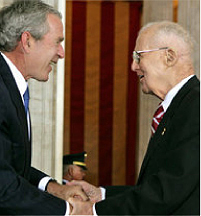
Borlaug died from cancer on Saturday at the age of 95 – a dénouement that received little coverage in a media cycle dominated by profane tennis players and incorrigible rappers. That a Nobel laureate, a recipient of the Presidential Medal of Freedom, and a winner of the Congressional Gold Medal could shed his mortal coil in such relative anonymity is lamentable. But Norman Borlaug wasn’t in the business of self-promotion; he was in the business of saving lives.
For those accustomed to thinking of greatness as a function of the will to power, Borlaug’s biography makes for an unlikely entry into the annals of the 20th century’s most important figures. Born into a farming family in Iowa, he failed his first college entrance exam and worked with the forest service before going on to graduate school. After earning his doctorate in plant pathology and genetics from the University of Minnesota, he eventually went to work in Mexico, where he was part of a team tasked with improving the country’s wheat production. The innovations that this humble scientist developed south of the border would permanently change the world for the better.
By crossbreeding different varieties of wheat, Borlaug discovered how to make the crop largely resistant to disease. He developed dwarf stocks that wouldn’t be lost when they tipped over because of excessive height. And he created a model of agricultural efficiency that could sustain the growing populations of impoverished nations. In short, he fed a generation.
By the time Norman Borlaug was done in Mexico, 95 percent of the country’s wheat lands were using his formula – and the country had been transformed from being heavily dependent on imports into being a net exporter of the crop. In the 1960s, he would take his methods to India and Pakistan, two starving nations that would also became self-sufficient because of his incredible insights. And in the twilight of his life, he set his sights on sub-Saharan Africa – where despite the impediments created by the continent’s governments, he managed such improbable feats as giving Ethiopia its largest harvest in recorded history. At the time of his death, Borlaug – with 95 years of generosity behind him – was said to lament only that he hadn’t been able to do more to lift the Dark Continent from the grip of poverty.
Such are the regrets of saints. But when Norman Borlaug arrived at Heaven’s gate, it is almost certain that he was not weighed in the balance and found wanting. Ten years ago, the Atlantic Monthly estimated that Borlaug’s work was responsible for saving over a billion lives. That is greater than the number of souls that were lost in the nuclear attacks on Hiroshima and Nagasaki by a factor of 5,000.
As we remember this great man, there are two lessons we can take from Norman Borlaug’s life.
First, for all of its frailties and fickleness, mankind remains stunningly creative in its compassion and compassionate in its creativity. Borlaug’s gift to civilization came along at the same time that Paul Ehrlich’s “population bomb” thesis was convincing elites throughout the world that hundreds of millions would die of starvation in developing nations like India. But like his intellectual progenitor, Thomas Malthus, Ehrlich’s calculations had overlooked an essential human factor – there is no such thing as fate when genius of mind is wed to generosity of spirit.
Second, even (and perhaps especially) the most noble of endeavors inevitably meet with opposition. Borlaug was criticized for the environmental impact of his methods, despite the fact that his high-yield farming techniques are estimated to have preserved an area of land equivalent in size to the state of California. And the economic growth that accompanied new, improved agriculture was said to exacerbate income inequality – a fate apparently worse than death by starvation.
On this topic the last word is probably best left to Borlaug, whose eloquence on the issue was unsurpassable: “Some of the environmental lobbyists of the Western nations are the salt of the earth, but many of them are elitists. They’ve never experienced the physical sensation of hunger. They do their lobbying from comfortable office suites in Washington or Brussels. If they lived just one month amid the misery of the developing world, as I have for 50 years, they’d be crying out for tractors and fertilizer and irrigation canals and be outraged that fashionable elitists back home were trying to deny them these things.”
Men like Norman Borlaug are rare. How does one define his legacy? To be honest, I don’t know. But I’d say there are at least a billion ways in the lives he saved.
|